The Professional’s Guide to the Concrete Slump Test
May 06, 2026
Why Concrete Quality Matters
In heavy construction and civil engineering, the quality of any structure is only as good as the materials behind it. Concrete remains the most essential of these materials forming the backbone of everything from residential foundations to highways, bridges, and high-rise towers. Yet despite its strength and versatility, concrete is highly sensitive to variations in composition. Even minor inconsistencies can quietly compromise structural integrity over time.
This is why quality control is a top priority on every serious job site. One of the most effective and time-tested methods for ensuring consistent concrete quality is the concrete slump test, a straightforward procedure that gives engineers and contractors an immediate read on fresh concrete before it's ever placed.
What Is the Concrete Slump Test?
The concrete slump test is a standardized field test used to measure the consistency of freshly mixed concrete. Governed by ASTM C143, the test determines how much a concrete sample subsides or "slumps" after a cone-shaped mold is removed. This measurement provides direct insight into the water-to-cement ratio, one of the most critical variables affecting concrete strength and long-term durability.
Water plays a dual role in concrete production. It is essential for the chemical hydration process, but excess water significantly weakens the finished structure. Too little, and the mix becomes difficult to place and compact properly. Striking the right balance requires precision and that starts with using properly calibrated concrete slump test equipment that meets ASTM C143 requirements.
Understanding Workability in Construction
Workability refers to how easily fresh concrete can be mixed, transported, placed, and compacted without segregation or bleeding. It is a fundamental factor in determining how well the concrete performs during finishing and different projects demand different levels of it.
Heavily reinforced structures like columns and beams typically require a higher slump value, allowing the mix to flow smoothly around dense steel reinforcement. Flat surfaces such as pavements and slabs call for a lower slump, a stiffer mix that delivers greater compressive strength. Maintaining this balance consistently across every batch is where systematic testing becomes indispensable.
For projects requiring a broader look at on-site quality checks, fresh concrete testing equipment covers a range of procedures beyond the slump test alone.
The Role of Slump Testing in Quality Control
On a busy construction site, multiple concrete deliveries may arrive throughout a single day. Variations in raw materials, mixing duration, or ambient temperature can all cause batch-to-batch inconsistencies and even one substandard pour can create weak points prone to cracking, shrinkage, or reduced load-bearing capacity.
Regular slump testing catches these issues before the concrete is placed, giving contractors the window to take corrective action. This proactive approach protects structural integrity, avoids costly rework, and keeps projects on schedule. For teams that also monitor concrete after placement, crack monitors and non-destructive concrete testing tools provide continued quality assurance throughout a structure's service life.
Step-by-Step Procedure of the Slump Test
While the slump test is relatively simple, it must be performed with care to produce reliable results:
- Prepare the surface — Place the slump cone on a flat, non-absorbent base plate and hold it firmly in position.
- Fill in three layers — Add fresh concrete in three equal layers, rodding each layer 25 times with a tamping rod to eliminate air pockets and ensure uniform density.
- Level the top — Strike off excess concrete so the cone is flush at the top.
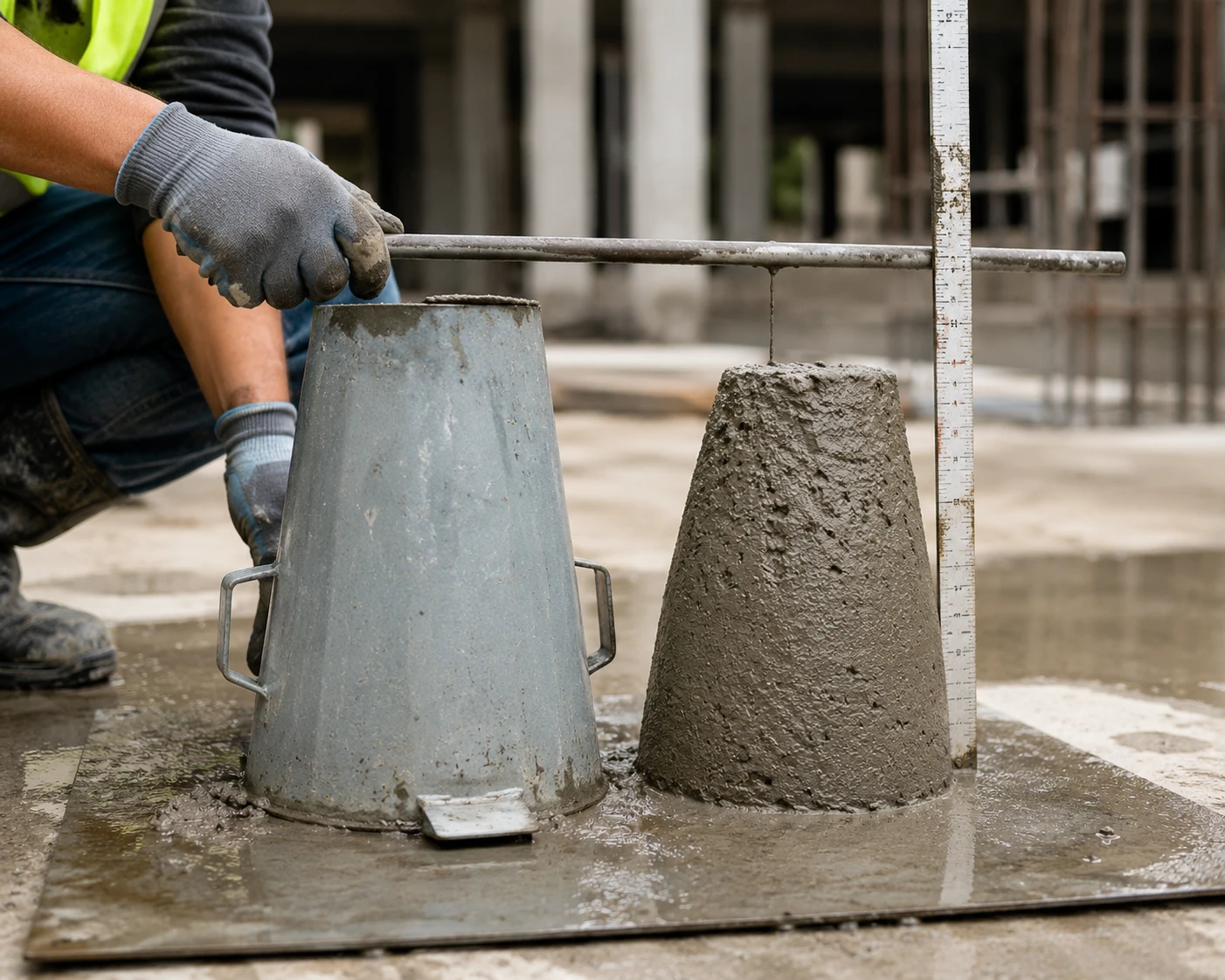
- Remove the cone — Lift the cone straight up in one smooth, controlled motion no twisting or tilting.
- Measure the slump — Place the cone beside the settled concrete and measure the vertical drop from the top of the cone to the highest point of the slumped concrete. That distance is the slump value.
Accuracy at every stage depends on consistent technique and well-maintained tools. The concrete testing category at Certified MTP covers the full suite of equipment needed for compliant, accurate testing on any job site.
Types of Slump and What They Mean
Knowing how to read slump results is just as important as running the test itself. There are three primary outcomes:
- True slump — The concrete settles evenly and retains its general shape. This is the target result, indicating a cohesive, well-proportioned mix.
- Shear slump — One side collapses or slides, suggesting poor cohesion or uneven mixing. When this occurs, the test should be repeated with a fresh sample.
- Collapse slump — The concrete falls apart entirely, indicating an overly wet or highly fluid mix — often due to excess water or aggressive admixture use.
Each outcome points to a specific problem or confirms a good mix making the slump test a powerful diagnostic tool, not just a verification step. Pairing slump testing with concrete compressive strength testing gives teams a complete picture of both fresh and hardened concrete performance.
Modern Advancements in Concrete Testing
Construction materials have evolved considerably in recent decades. High-performance concrete and self-consolidating concrete (SCC) are now common on large-scale projects, offering superior strength and flowability. These materials often require modified procedures such as the slump flow test to accurately capture their behavior.
Even so, the foundational principles of slump testing remain unchanged and universally applicable. It continues to be one of the most reliable methods for assessing concrete consistency in real time, regardless of mix design or project scale. For teams working with hardened concrete, concrete strength measurement tools and concrete scanning equipment extend quality assurance well beyond the initial pour.
Choosing the Right Equipment for Accurate Results
No testing procedure is more reliable than the equipment behind it. Essential slump test tools cones, tamping rods, and base plates must all meet ASTM specifications to ensure results are meaningful and defensible. Substandard or worn equipment introduces measurement error that can lead to incorrect decisions and, ultimately, compromised structures.
Investing in quality, ASTM-compliant concrete slump test equipment is not an overhead cost, it's a safeguard against far more expensive problems down the line. Teams managing a full testing program will also find value in exploring the broader concrete testing equipment range for complementary tools.
Why the Slump Test Remains Essential
The concrete slump test is far more than a routine box to check it's a critical quality gate between design intent and physical execution. By providing immediate, actionable insight into concrete consistency and workability, it ensures every batch meets specification before a single pour is made.
In an industry where safety, durability, and performance are non-negotiable, that kind of certainty matters. Whether the project is a modest residential build or a major infrastructure development, the slump test continues to be one of the simplest and most valuable tools a construction professional can rely on.