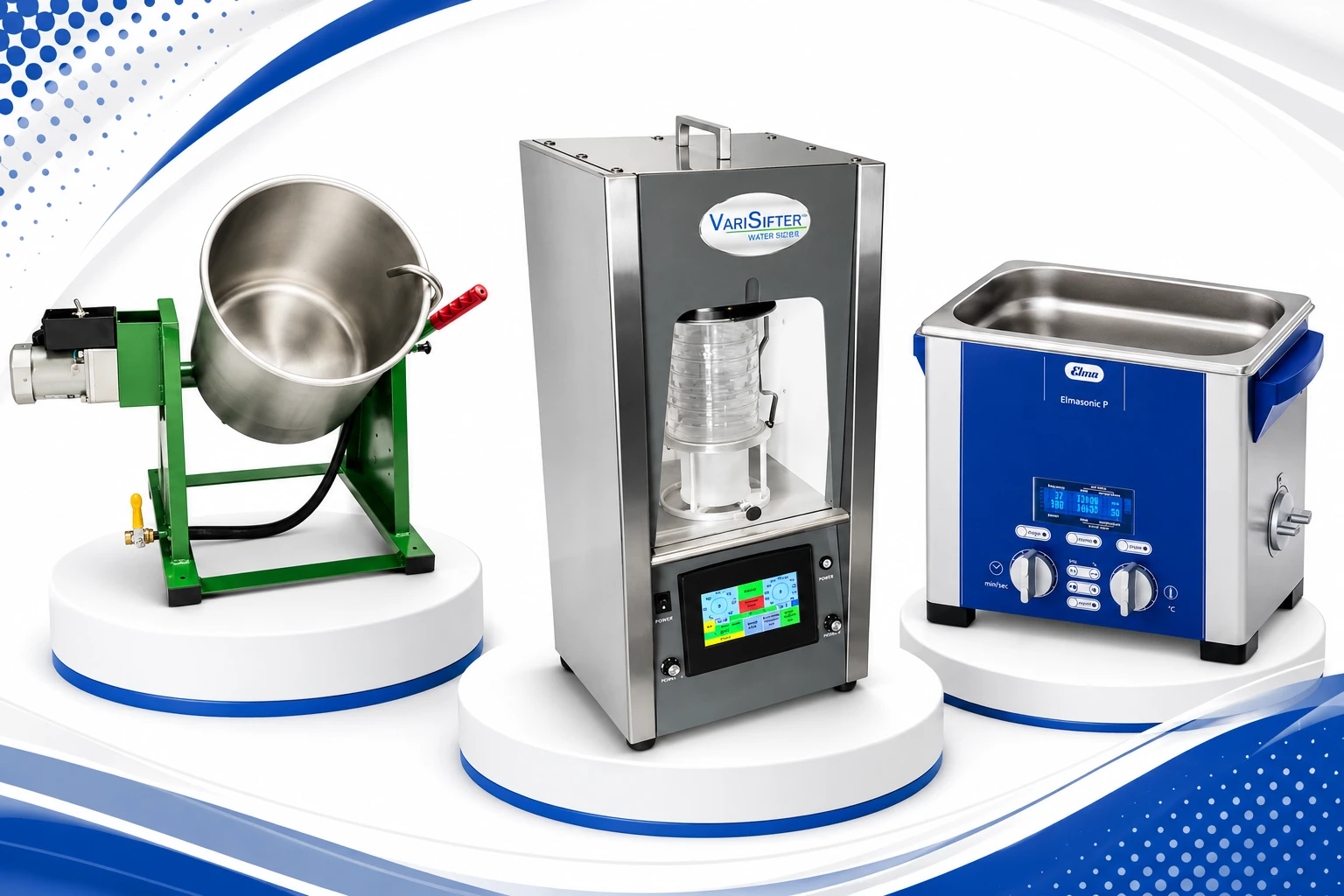
Ultrasonic Sieve Cleaners & Cleaning Baths
Separate Cleaning Equipment from Separation Equipment
Ultrasonic sieve cleaners use cavitation in a liquid bath to loosen particles trapped in sieve mesh. They maintain test sieves; they do not perform sieve analysis. Do not substitute a cleaning bath for a sieve shaker or a rotary sifter, and confirm the sieve manufacturer's approval before ultrasonic cleaning of any mesh.
Match the cleaner to the sieves you maintain: tank dimensions, sieve capacity and holder arrangement determine which sieves fit. Verify each model's specifications rather than assuming one bath serves every frame diameter.
Compare Dedicated Sieve-Cleaning Units
Dedicated units are sized by sieve diameter. Compare the Ultrasonic Sieve Cleaner for 3in Sieves, for 8in and Smaller Sieves and for 8in or 12in Test Sieves against your sieve inventory and batch requirements.
Check each listing's stated capacity—such as how many full-height 8in sieves fit simultaneously—along with frequency, generator configuration and tank material. The 8in-and-smaller unit separates the ultrasonic generator from the stainless-steel tank; confirm the arrangement and required connections for the selected model.
Consider General-Purpose Ultrasonic Baths
Elmasonic E+ series baths are listed in several tank sizes, including the 0.5-Gallon EP20H and 2.5-Gallon EP100H. These general-purpose baths serve varied laboratory cleaning tasks; confirm tank dimensions and any required sieve holder before using one for sieves.
Where a dedicated sieve rack is not included, check compatibility separately—items such as the Stainless Sample Basket for the 3in Sieve Cleaner are model-specific. Do not assume baskets, racks or heaters transfer between different ultrasonic units.
Plan Solution, Utilities and Cleaning Practice
Use the approved cleaning solution: Detergent Concentrate for Ultrasonic Bath is listed for these units. Confirm dilution, solution change intervals and disposal requirements, and avoid solvents or chemicals the manufacturer has not approved for the tank and sieves.
Verify electrical supply and drain access for the selected unit, following the manufacturer's installation and filling instructions. Establish a cleaning routine that inspects mesh condition before and after cleaning, and keep sieve cleaning brushes available for meshes where brushing—not ultrasonic cleaning—is the approved method.