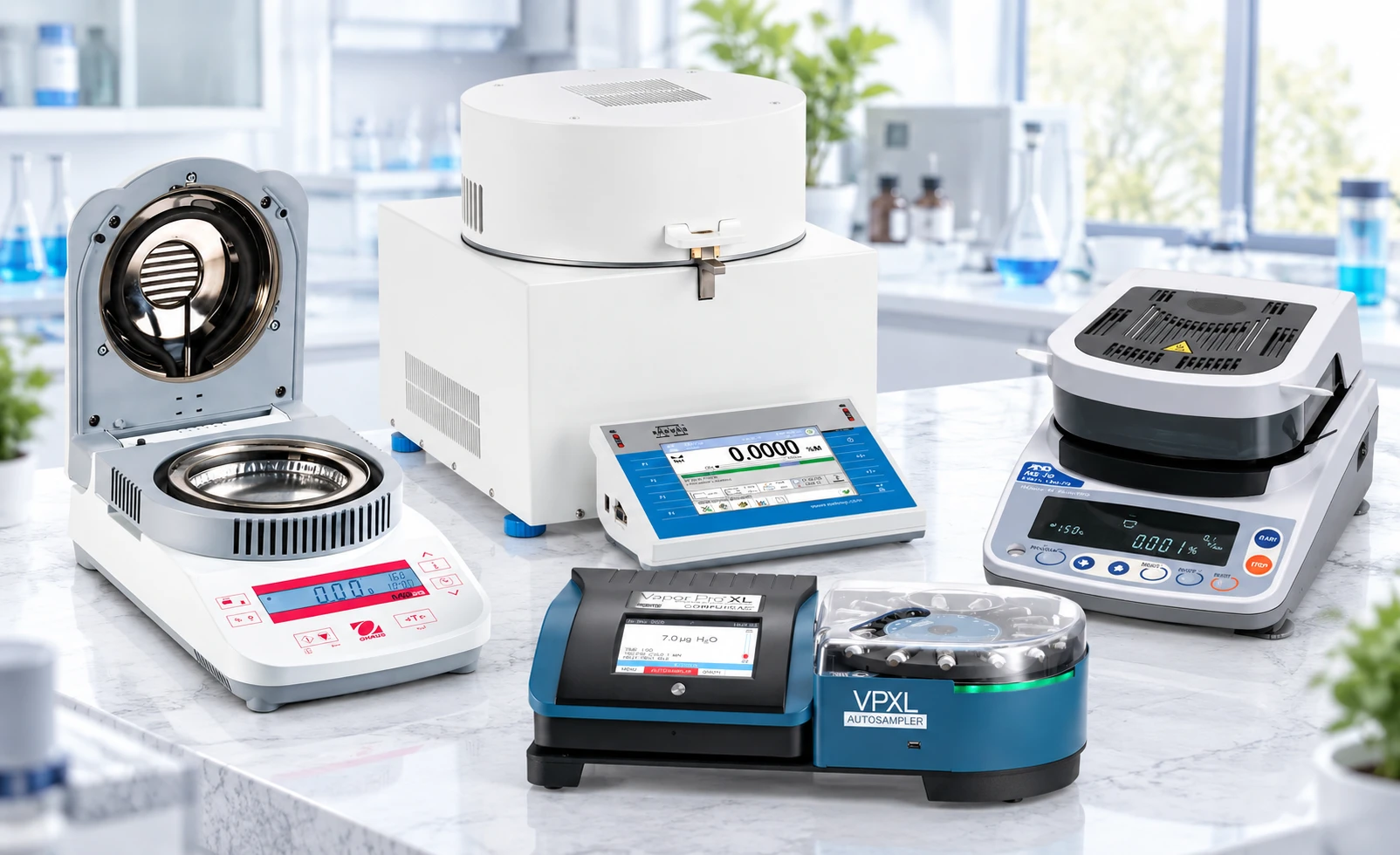
Laboratory Moisture Analyzers (Loss-on-Drying Balances)
Understand What a Moisture Analyzer Does
A laboratory moisture analyzer determines moisture content by loss on drying: it weighs a sample, heats it with a lamp or heating element, then re-weighs until the chosen endpoint. Results depend on sample preparation, temperature profile and shut-off criteria, so match the instrument to the governing method rather than treating every analyzer as interchangeable.
Moisture analyzers are not ambient humidity meters, gas detectors or reagent-type aggregate moisture testers. Keep this equipment separate from those alternatives; a combined weighing-and-heating instrument cannot substitute for a different test principle.
Match Capacity and Readability to the Sample
Check the maximum sample load and the displayed increment: for example, the Ohaus MB120 lists 120g capacity with 0.001g readability, the Adam PMB 53 lists 50g with 0.001g, and the A&D MX-50 lists 51g with 0.001g. Verify the exact model; capacity and readability vary within each family.
Confirm repeatability statements in the product's own specifications, and the sample size they assume. A small sample weight can be normal for one analyzer and unsuitable for another method. Pan size and sample spreading also affect drying uniformity.
Compare Heating Control and Endpoints
Review heating technology (for example halogen), the temperature range and the available drying profiles—standard, rapid, ramped or stepped—on the selected model. Endpoint control may be manual, timed or automatic based on weight change; confirm which criteria the instrument supports.
For materials that spatter, degrade or contain volatile components, check the manufacturer's guidance for suitable profiles and sample preparation. Do not assume one temperature setting suits every material; follow the applicable test procedure.
Check Data Handling and Consumables
Confirm storage capacity for methods and results, interface ports (USB, RS-232) and printer or software compatibility for the exact model. The Ohaus MB120 listing, for example, describes 100 stored methods and 1,000 results; these figures are model-specific.
Order compatible consumables: disposable or reusable sample pans, glass-fiber pads for liquids or semi-solids and pan handles. The MB120 listing includes 80 aluminum sample pans; other models may supply fewer or none. Verify quantities before ordering rather than assuming inclusion.
Support the Method with Verification
Where your quality system requires performance checks, select suitable calibration weights and follow the analyzer's instructions for adjustment and verification. Heating performance may also require its own checks; confirm the manufacturer's recommended procedure.
For general weighing without drying, use the main balances and scales range. Keep moisture-analyzer results tied to the documented method—temperature, endpoint and sample preparation—not to a single displayed percentage alone.