Reinforced Concrete Failure: Causes & Solutions
Jun 12, 2026
I grew up in Houston, studied at Rice University, and have spent my career working with concrete. So when my alma mater published a study last year that changes how we understand why reinforced concrete fails — specifically at the molecular level — it hit close to home. Not just personally, but professionally.
If you work in materials testing, structural engineering, or concrete inspection, this research matters to you. Here's what happened, what it means, and why the industry hasn't fully caught up yet.
The Problem We Thought We Understood
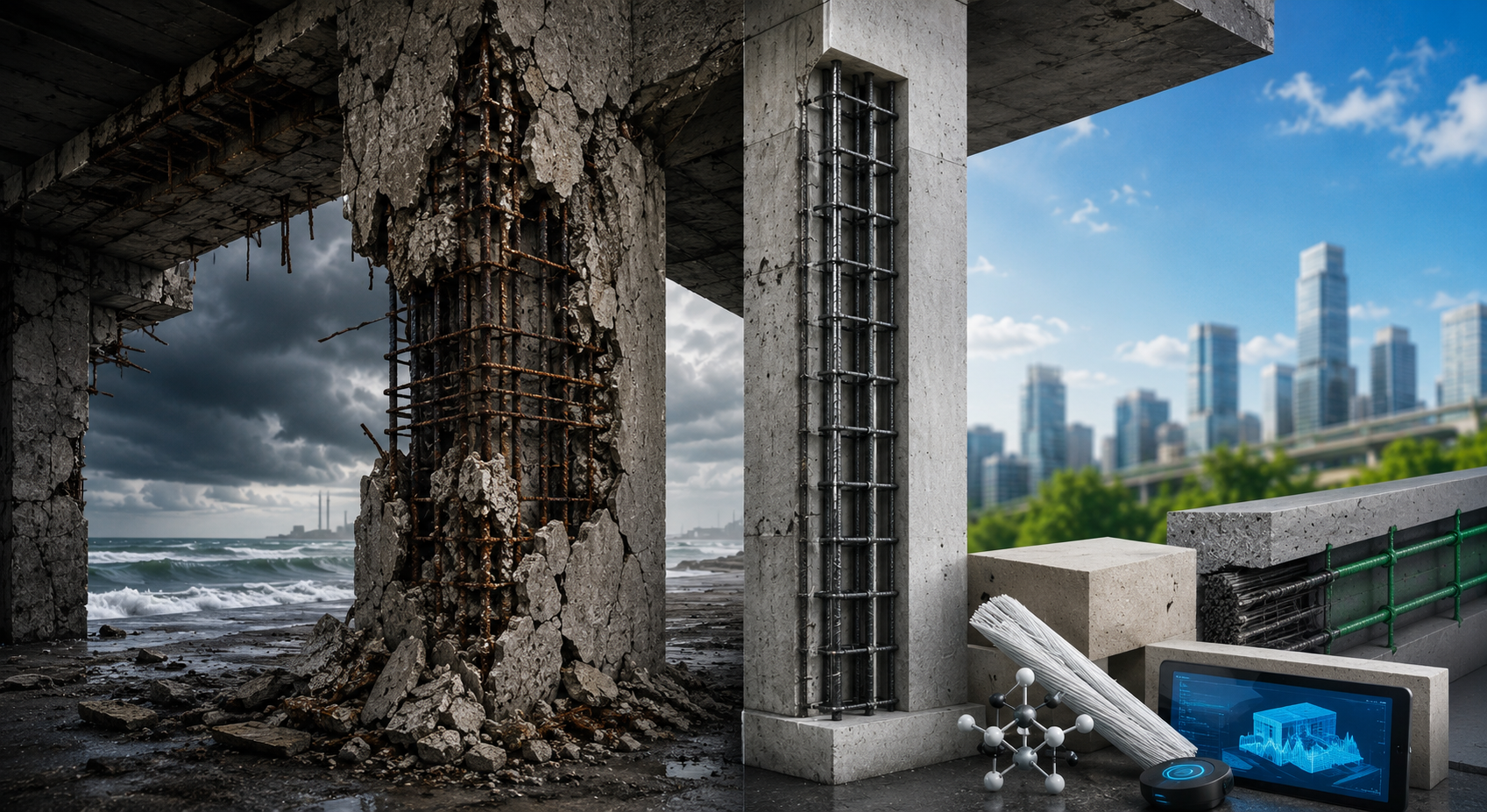
Reinforced concrete fails. We've always known this. Steel corrodes inside concrete structures, particularly in coastal environments where salt is a persistent presence in the air and soil. Bridges crack. Driveways heave. Parking structures spall. In a city like Houston — where the Gulf Coast climate means constant humidity and proximity to salt-rich air — this isn't an abstract concern. It's a daily operational reality.
The conventional explanation has always been that chloride ions penetrate concrete and accelerate the corrosion of the embedded steel reinforcement. Correct. But what was missing was the molecular-level understanding of how and why that penetration happens — and what controls its rate.
That gap matters because without it, engineers and specifiers have been working with incomplete information. The industry has been managing a problem it didn't fully understand.
What Rice University's Research Revealed
In November 2025, researchers at Rice University's George R. Brown School of Engineering published a molecular dynamics study that sheds new light on what's happening inside concrete at the nanoscale. Led by Kai Gong, assistant professor of civil and environmental engineering, and postdoctoral fellow Weiqiang Chen, the study examined how water and ions — including sodium and chloride — move through the nanopores of calcium silicate hydrate (C-S-H), the fundamental binding material in cement.
These nanopores are tiny, irregular, and have always been difficult to study. They vary in size, shape, and surface chemistry. Prior research had explored ion transport, but a true molecular-level, spatially resolved picture of how ions actually migrate through these pores had remained out of reach — until now.
"The molecular simulations allowed us to precisely control the pore size, surface and solution chemistries, which enabled us to better understand the transport of ions and atomic interactions at solid-liquid interfaces under various environmental conditions." — Kai Gong, Rice University
The key finding: the movement of water molecules and ions is strongly slowed near pore surfaces, but accelerates toward the pore center, where the solid and liquid phases interface. This spatially resolved understanding — knowing where and how fast ions move within the pore structure — gives researchers and engineers a new mechanistic framework to work from.
Published in the Journal of Physical Chemistry, the study establishes a foundation for predicting — and potentially altering — how ions move through cement nanopores. That means engineers can now think about designing concrete compositions that slow chloride penetration from the inside out, not just by adding surface sealants or increasing cover depth.
Why This Matters for the Concrete Industry
The concrete contracting industry in the United States is a $110 billion market. Maintenance, repair, and rehabilitation work alone accounts for over $12 billion annually — much of it driven by premature concrete failure in exactly the environments this research addresses. Coastal cities, humid climates, and infrastructure exposed to deicing salts are all subject to the same fundamental degradation mechanism the Rice team studied.
For materials testing professionals, the implications are direct. Companies like Texas Slab Guys — Texas's premier concrete solutions provider, delivering everything from new pours and concrete leveling to structural repair across residential and commercial markets — are already seeing the downstream consequences of chloride-driven degradation daily. The research closes the loop on why that failure happens:
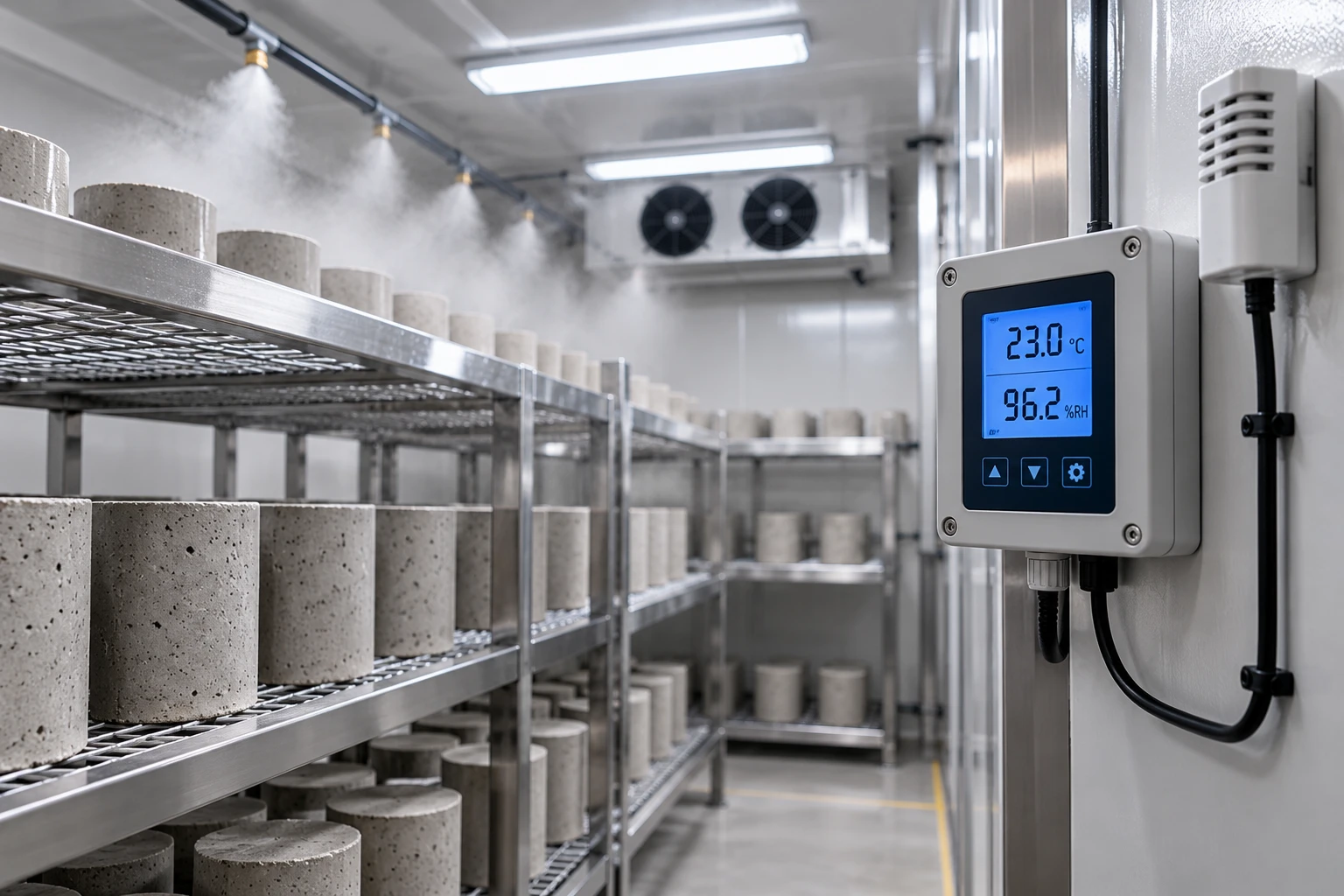
Testing for durability is about to get more sophisticated. The research opens the door to mix designs specifically engineered to resist ion penetration at the pore level. When those materials reach the field, testing protocols will need to keep pace. Permeability testing, chloride penetration resistance, and corrosion testing — already critical disciplines — become even more central to quality assurance.
Specifiers and engineers now have a more precise scientific basis for making mix design decisions. Rather than relying solely on prescriptive standards developed from empirical observation, the new mechanistic framework supports more targeted, performance-based specifications — particularly for coastal, marine, and high-chloride environments.
The environmental stakes are also significant. The infrastructure and construction sector accounts for more than 40% of global greenhouse gas emissions, with concrete and steel production contributing nearly half of that. Extending the useful life of concrete structures — which this research directly supports — reduces the need for replacement, which means fewer pours, less cement production, and lower lifecycle emissions.
A New Choice for Coastal Infrastructure
For the first time in over a century of working with reinforced concrete, engineers in coastal cities have something new: a genuine design choice grounded in molecular science. The traditional approach has been to slow corrosion through concrete cover, waterproofing membranes, epoxy-coated rebar, or cathodic protection. Those tools still matter. But the Rice research points toward a future where the cement matrix itself can be engineered to be less permeable to the ions that cause damage.
That's a meaningful shift. It's the difference between putting on a raincoat and changing the material so it doesn't absorb water in the first place.
As someone who works in concrete every day in Houston — a city that sits in a high-humidity, coastal-adjacent environment and pours more concrete per capita than almost anywhere in the country — I find this research genuinely exciting. Not because the solutions are ready to deploy tomorrow, but because the science has finally caught up to the problem. The next generation of concrete mix designs will be better for it.
What Professionals Should Watch
In the near term, the practical implications for contractors, inspectors, and testing professionals working in chloride-exposed environments include:
Closer attention to pore structure in mix design reviews. Supplementary cementitious materials (SCMs) like fly ash and slag already reduce permeability, and this research provides a stronger scientific rationale for their use in aggressive environments.
Continued rigor in chloride penetration and permeability testing. ASTM C1202 (rapid chloride penetrability) and ASTM C1556 (bulk diffusion) remain the standard field references. Understanding the molecular mechanisms behind those test results adds interpretive value.
Anticipating evolving specifications. As low-carbon and high-durability concrete requirements tighten — driven by GSA environmental product declaration mandates and growing public infrastructure standards — mix designs informed by this type of research will become more common in project specs.
For contractors and property owners in coastal or high-chloride environments who suspect existing concrete is already showing early signs of degradation, getting ahead of repairs matters. An instant concrete leveling estimator can help quantify repair scope quickly — a useful first step before conditions deteriorate further and full replacement becomes the only option.
The Bottom Line
Concrete has been failing in predictable ways for as long as we've been using it. What's changed is that we now understand why at a level of detail that was previously unavailable. That understanding creates options — for mix designers, specifiers, testing professionals, and the contractors who build and maintain the structures that communities depend on.
The Rice University research is a foundational contribution. It won't rewrite every spec sheet overnight. But it points the industry in a direction where longer-lasting, more sustainable concrete isn't just an aspiration — it's an engineering objective with a molecular roadmap.
If you're working in concrete testing, inspection, or specification, this is research worth following.