
Vicat Test for Cement: What It Measures, How It Works, and Why It Matters
Aug 24, 2026
Cement may look like a simple construction material, but its performance depends on several measurable properties. One of the most important is how quickly the cement paste begins to lose its plasticity and eventually becomes rigid. If cement sets too quickly, workers may not have enough time for mixing, transporting, placing, and finishing. If it sets too slowly, construction schedules can be affected and the material may not perform as expected. This is why determining the setting characteristics of cement is an important part of quality control.
The Vicat test for cement is a widely used laboratory method for evaluating the setting behavior of hydraulic cement. The test uses a Vicat apparatus and specially designed needles or plungers to measure how the cement paste resists penetration as it changes over time. The results help laboratories and manufacturers assess whether cement meets the requirements established for a particular application.
For laboratories looking for reliable cement testing equipment, understanding what the Vicat test measures, how the test works, and how to select the appropriate apparatus is essential.
What Is the Vicat Test for Cement?
The Vicat test for cement is used to determine the setting time and, depending on the procedure, the consistency of cement paste. The test is based on penetration: a plunger or needle is brought into contact with a prepared cement paste, and the depth of penetration is observed.
As cement hydrates, the paste gradually becomes less workable. At the beginning, a needle can penetrate the paste relatively easily. As hydration progresses, the paste becomes increasingly resistant to penetration. The changes in penetration are used to identify important points in the setting process.
The test is particularly associated with the determination of initial setting time and final setting time. ASTM C191-26, the current ASTM standard for time of setting of hydraulic cement by the Vicat needle, recognizes both a manually operated standard Vicat apparatus and qualifying automatic Vicat machines.
Certified MTP offers a dedicated Vicat Test Equipment collection that includes equipment designed for cement consistency and setting-time testing.
Why Is Cement Setting Time Important?
Setting time is more than just a laboratory measurement. It provides information about how cement will behave during construction and helps establish whether a cement product is appropriate for its intended use.
Once cement is mixed with water, hydration begins. The material does not immediately become hard. Instead, it passes through a gradual transition from a workable paste to a material with increasing rigidity. The setting-time test helps characterize this transition.
Initial setting time is important because it indicates when the cement paste begins to lose its plastic characteristics. Before this point, the material can generally be manipulated more easily. This is particularly relevant to construction operations where cementitious materials must be mixed, placed, shaped, or finished.
Final setting time represents a later stage in the process when the paste has developed considerably more rigidity. It provides another useful quality-control reference for understanding the cement's setting behavior.
It is important to remember that the setting time measured for hydraulic cement paste is not necessarily the same as the setting time of mortar or concrete. ASTM specifically notes this distinction in C191.
What Does a Vicat Apparatus Measure?
A Vicat apparatus measures penetration resistance in a cement paste under controlled testing conditions. Depending on the test being performed, the apparatus can use a plunger or needle with defined dimensions and mass.
A traditional apparatus generally consists of a rigid frame, movable rod, penetration component, graduated scale, and a platform or base for holding the specimen. The design allows the operator to lower the penetration component into the cement paste and observe the resulting penetration.
For laboratories conducting regular quality-control testing, a standard manually operated apparatus can be an effective option. For laboratories performing a high volume of tests, an automatic or computer-controlled system can reduce manual intervention and provide more consistent data collection.
Certified MTP's Standard Vicat Apparatus is designed for testing the consistency and setting times of hydraulic cement, mortar, and grout.
Initial Setting Time vs. Final Setting Time
The two most important measurements associated with the Vicat setting-time test are initial and final setting time.
Initial Setting Time
The initial setting time of cement indicates the point at which the cement paste has begun to lose its plasticity to a defined degree. During the test, penetration measurements are taken at specified intervals. As the paste stiffens, the needle penetrates less deeply.
The initial set is identified according to the penetration criterion specified by the applicable test method. It provides a standardized way of comparing the setting behavior of different cement samples.
This information is particularly useful for quality-control laboratories because unusually rapid or slow settings can indicate a change in material characteristics, formulation, storage conditions, or other factors.
Final Setting Time
The final setting time of cement represents a later stage in the setting process. At this point, the cement paste has become sufficiently rigid that it meets the final-set criterion specified by the applicable standard.
Together, initial and final setting times provide a more complete picture of the cement's setting behavior than either measurement alone.
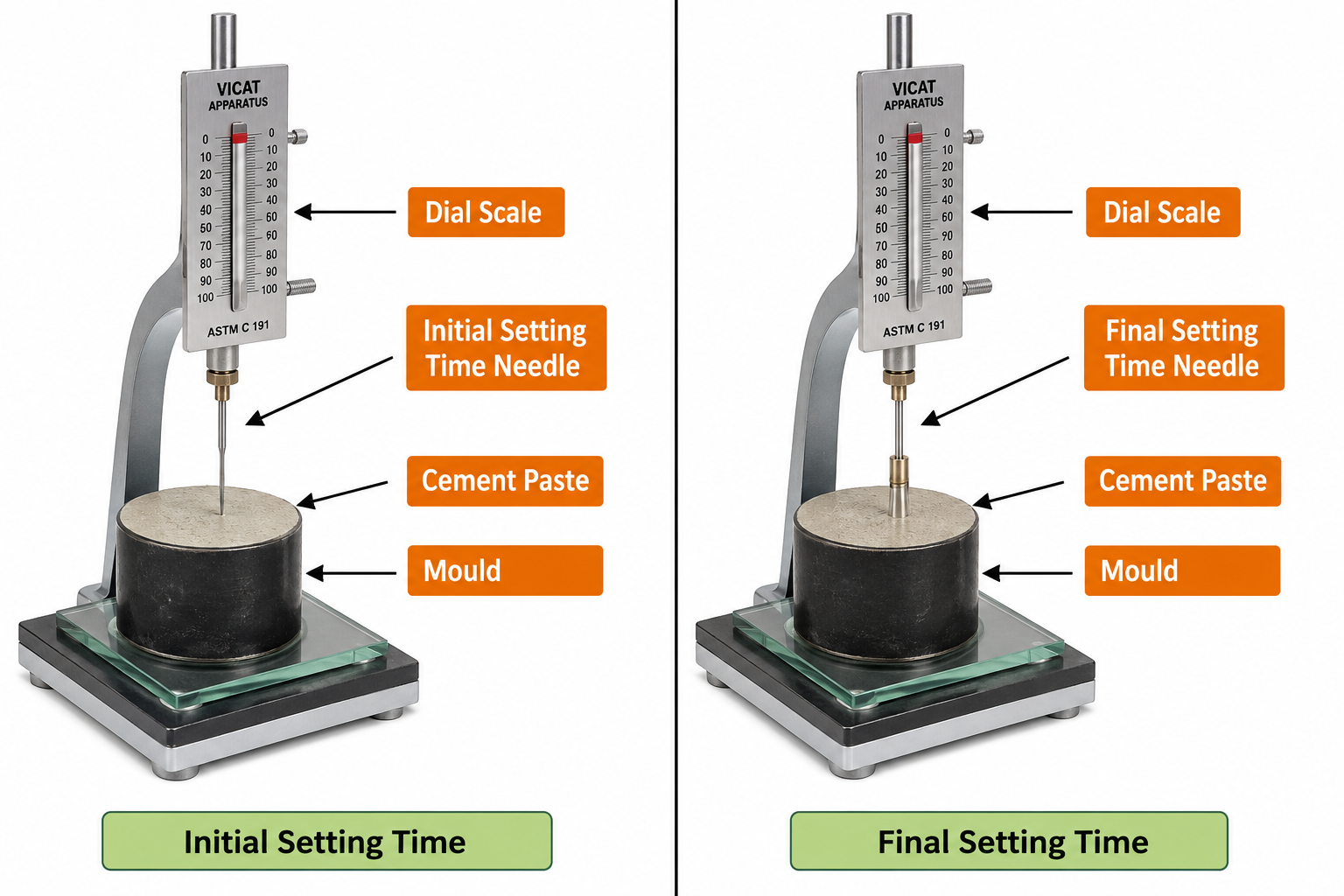
How Does the Vicat Test Work?
Although exact procedures should always follow the applicable testing standard, the general process involves preparing a cement paste, placing it into a suitable mold, and measuring penetration at controlled intervals.
1. Prepare the Cement Paste
A representative cement sample is mixed with water according to the requirements of the applicable test method. Proper sample preparation is critical because differences in water content, mixing, temperature, or handling can affect the resulting setting time.
The consistency of the paste is especially important when performing related consistency and setting-time tests. A controlled preparation procedure helps make results repeatable between samples.
2. Fill the Vicat Mold
The prepared cement paste is placed into the appropriate Vicat mold. The paste should be handled according to the applicable standard so that the test specimen has the required shape and condition.
Poor specimen preparation can introduce variability into penetration measurements, making it more difficult to compare results.
3. Position the Apparatus
The mold is positioned beneath the penetration component of the Vicat apparatus. The apparatus must be properly adjusted and maintained so that the penetration measurements are accurate.
Laboratories should also pay attention to equipment condition, cleanliness, calibration, and environmental conditions.
4. Measure Penetration
The Vicat needle or plunger is brought into contact with the cement paste at specified intervals. The penetration depth is recorded.
As hydration progresses, penetration decreases because the paste becomes progressively stiffer.
5. Determine Setting Times
The recorded penetration measurements are evaluated against the criteria specified by the applicable test method. This allows the laboratory to establish the initial and final setting times.
ASTM C191-26 provides two approaches: a reference method using a manually operated standard Vicat apparatus and an automatic method using a qualifying automatic Vicat machine.
What Equipment Is Needed for a Vicat Test?
A reliable cement setting time test requires more than simply having a needle and a frame. The laboratory needs equipment that is appropriate for the selected standard and capable of producing repeatable measurements.
Typical equipment may include:
- Vicat apparatus
- Vicat needles
- Vicat mold
- Base plate
- Cement mixing equipment
- Measuring equipment
- Appropriate water supply and containers
- Timing equipment
- Environmental control equipment where required
Certified MTP's Cement Testing Equipment category includes Vicat apparatus and needles along with equipment for consistency, soundness, compressive strength, fineness, and other cement tests.
For laboratories seeking a higher level of automation, Certified MTP's Automatic Vicat Apparatus can automatically determine the initial and final setting times of cement or mortar pastes. The listed model supports standards including AASHTO T131 and EN 196-3.
Manual vs. Automatic Vicat Apparatus
One of the decisions laboratories may face is whether to use a manual or automatic system.
A standard Vicat apparatus requires the operator to perform the penetration measurements and record the observations. This approach can be suitable for laboratories conducting routine testing where test volume is manageable and trained technicians are available.
An automatic Vicat apparatus, on the other hand, can automate much of the measurement process. This can be particularly useful when a laboratory performs numerous tests and wants to reduce repetitive manual measurements.
Certified MTP also offers Computer-Controlled Vicat Apparatus designed to automatically monitor the setting process and generate setting curves.
For laboratories handling multiple samples, an 8-Station Computer-Controlled Vicat Apparatus is another option. The system is designed to monitor multiple test stations and automatically register initial and final set times.
The right choice depends on factors such as testing volume, required automation, available laboratory space, budget, and the specific standard being followed.
Common Factors That Can Affect Vicat Test Results
Even good cement testing equipment cannot compensate for inconsistent sample preparation or poor laboratory practices. Several factors can influence Vicat test results.
Water Content
The amount of water used to prepare the cement paste can significantly affect its consistency and setting behavior. Small variations can influence penetration measurements and make comparisons between samples less reliable.
Temperature
Cement hydration is affected by temperature. For this reason, test environments and materials should be controlled according to the requirements of the applicable standard.
Mixing Procedure
Differences in mixing time, mixing technique, or the sequence of adding materials can affect the condition of the cement paste.
Equipment Condition
Dirty needles, damaged components, incorrect positioning, or problems with the measurement scale can introduce errors. Equipment should be inspected and maintained regularly.
Timing
Because the setting process changes continuously, accurate timing is important. Delays between measurements can influence the recorded setting time.
Operator Technique
Manual Vicat testing requires consistent technique. Different operators may obtain different results if they do not follow the same preparation and measurement procedures.
Standards for the Vicat Test
The appropriate standard should always be identified before testing begins because test requirements can differ depending on the material and application.
ASTM C191-26 is titled Standard Test Methods for Time of Setting of Hydraulic Cement by Vicat Needle and provides both manual and qualifying automatic approaches.
Certified MTP's Vicat equipment listings identify support for several standards depending on the particular apparatus. For example, its automatic Vicat apparatus listing references AASHTO T131, EN 196-3, DIN 1164, DIN 1168, NF P15/43, and BS4550.
Because standards can be revised, laboratories should verify the current edition and exact applicability of a test method before conducting acceptance or compliance testing.
How to Choose a Vicat Apparatus
Choosing the right Vicat apparatus for cement starts with identifying what you need the equipment to accomplish.
For a laboratory performing occasional or routine manual testing, a standard apparatus may provide the functionality needed without the additional complexity of automation.
For laboratories with higher sample volumes, an automatic system may be more practical. Automated equipment can help reduce repetitive tasks and standardize data collection.
It is also important to check:
- Applicable testing standards
- Measurement range and accuracy
- Included needles and molds
- Number of testing stations
- Manual or automatic operation
- Data recording capabilities
- Ease of cleaning and maintenance
- Laboratory space requirements
- Availability of replacement components and accessories
Certified MTP provides several Vicat Apparatus options, making it possible to compare equipment based on the testing requirements of your laboratory.
Why Accurate Cement Testing Matters
Cement quality has a direct relationship with the performance of cement-based construction materials. While setting time alone does not determine overall cement quality, it is an important characteristic that laboratories can monitor alongside other properties.
A comprehensive cement testing program may include consistency, fineness, soundness, compressive strength, setting time, and other tests depending on the cement type and applicable specifications.
Certified MTP's cement-testing range includes Cement Compressive Strength Testing, Cement Fineness Testing, Cement Autoclaves, and other equipment that can support a broader laboratory testing program.
Using the appropriate test equipment and following a consistent procedure helps laboratories produce results that are useful for quality control, research, product development, and specification compliance.
Final Thoughts
The Vicat test for cement provides a standardized way to evaluate important setting characteristics of hydraulic cement. By measuring penetration as cement paste changes from a workable material to a progressively stiffer one, laboratories can determine initial and final setting times under the conditions specified by the applicable test method.
The quality of the results depends on more than the apparatus itself. Proper sample preparation, controlled testing conditions, accurate timing, equipment maintenance, and consistent operator technique all contribute to reliable measurements.
For laboratories looking to establish or expand their cement-testing capabilities, selecting the right Vicat apparatus, needles, molds, and supporting equipment is an important first step. Certified MTP's range of cement testing equipment and Vicat testing equipment provides options for both manual and automated testing applications.
When combined with other cement quality tests, Vicat testing can give laboratories valuable insight into material behavior and help ensure that cement is evaluated consistently before it is used in construction.