Why Asphalt Density Testing Matters for Durable Pavements
Jul 15, 2026
Drive around long enough and you'll notice it. Some roads take everything a decade of traffic and weather can throw at them and barely show it. Others start cracking and rutting before the paint stripes even fade. Same trucks driving over them, sometimes even similar mixes going down. So what's the difference?
Usually, it's density.
Density is just a measure of how tightly the asphalt packed together once the rollers finished doing their thing. Get it right and the road ends up strong, flexible, and able to shed water the way it's supposed to. Get it wrong and it almost doesn't matter how good the materials were, because the pavement is going to fail early anyway. That's the reason density testing has become such a big deal on paving crews, even ones that used to treat it as an afterthought.
So why does it matter this much, how do crews actually measure it out in the field, and what does a testing routine look like when it's done right instead of just for show? That's what the rest of this covers.
What Asphalt Density Actually Means
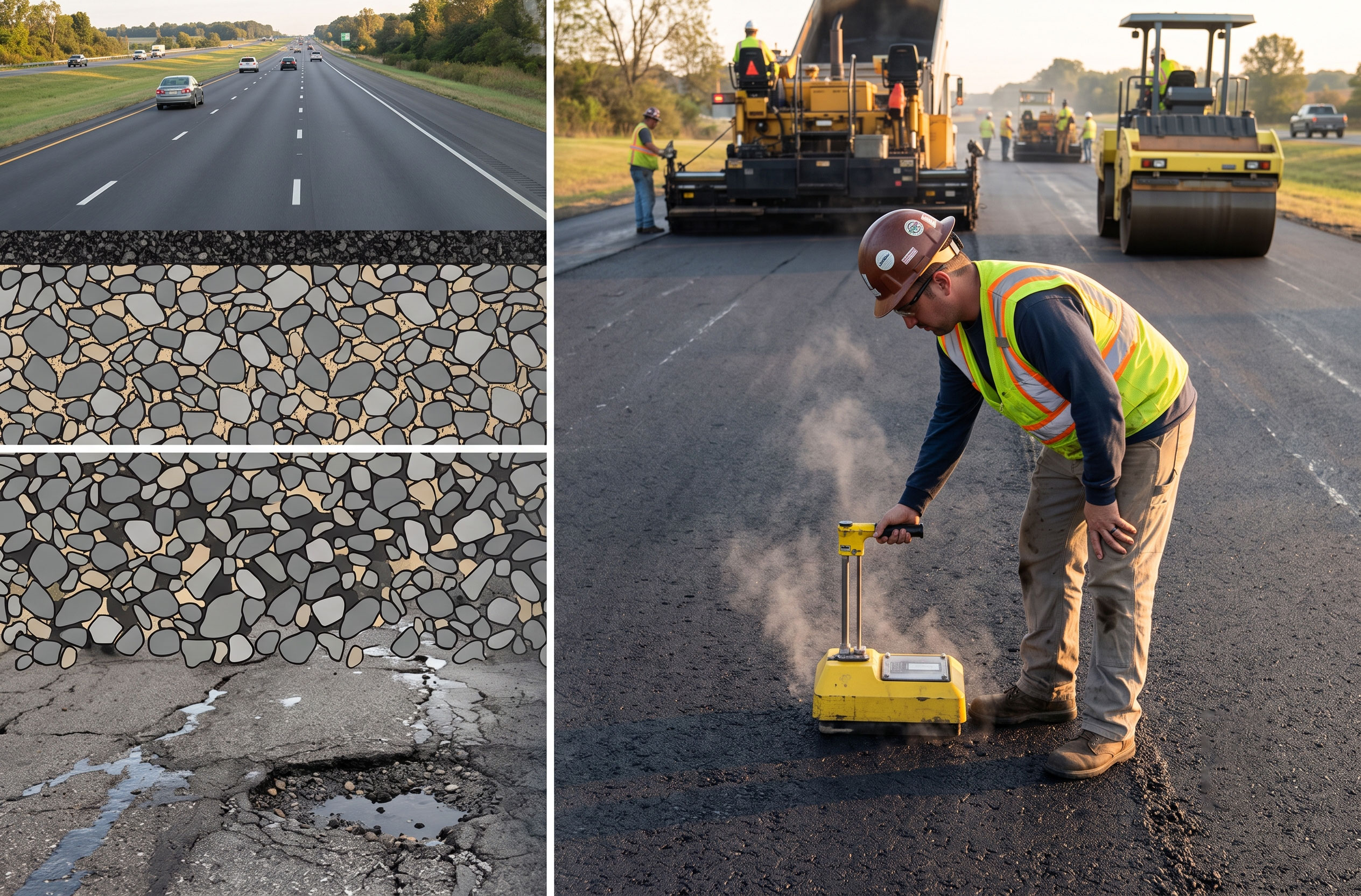
Asphalt itself isn't complicated: aggregate, sand, and binder mixed together. What's interesting is what happens right after it comes off the paver, while it's still hot. That fresh mix is full of tiny trapped air pockets, and engineers have a name for these, air voids. Compaction is the process that squeezes those pockets out, pushing everything into a tight, interlocked structure.
Density is the report card for how well that squeezing job went. More compaction, generally speaking, means fewer voids and a tighter bond holding the particles together. Not enough compaction, and you're left with gaps: little doorways for water, air, and stress to sneak in over time.
Engineers typically describe density as a percentage of something called theoretical maximum specific gravity. It's a lab number representing what the mix would be if it had zero air voids at all, a sort of theoretical ceiling. You don't actually want to hit that ceiling exactly. (More on why in a bit.) But getting close to it is basically what separates a pavement that lasts years from one that barely makes it through a couple of seasons.
Why Density Decides How Long a Road Lasts
Out of all the numbers involved in this whole process, air voids probably matter most for how long a road ends up lasting. Most well-compacted pavement sits somewhere around 7 to 8 percent, though that's not some arbitrary line someone drew. It roughly lines up with the point where strength and flexibility even out, giving the road enough give to handle temperature swings and heavy loads without breaking down. Get much higher than that, and things tend to go sideways fast.
Once water works its way into those gaps, it starts stripping binder off the aggregate, and that weakens the base from underneath. Traffic keeps flexing the loose particles, which speeds up fatigue cracking. Oxygen gets in and ages the binder faster than it should, so the surface goes brittle and starts raveling. And rutting just gets worse as the whole mixture shifts underneath the wheel paths.
There's a rough industry rule worth remembering: every one percent rise in voids above that ideal band can cut a pavement's expected life by something like ten percent. That's a lot of lost service life for what often comes down to a few missed passes with a roller, which is exactly why crews take accurate readings so seriously.
How Crews Actually Measure Density
Getting a trustworthy density number takes more than glancing at a finished mat and calling it good. A handful of tested methods are out there, and each comes with its own trade-offs.
Nuclear density gauges are still the workhorse on most sites. They're portable, quick, and hand you a reading within a couple of minutes by firing gamma rays into the pavement and measuring what bounces back. Non-nuclear versions do something similar using dielectric sensors instead, which means crews can skip the licensing and safety hoops that come with anything radioactive.
Core sampling is the older, slower route. Technicians drill actual cylindrical plugs out of the finished surface and send them off to a lab. It's destructive, and it takes longer to get results, but it's also the most accurate method around, since someone is physically weighing and measuring a real sample instead of estimating from above. Ground-penetrating radar has also been picking up steam lately, offering continuous readings across a whole stretch of road without damaging anything.
If you're weighing which method actually fits your project, this breakdown of density testing methods is a decent place to compare how each one performs in practice.
Density and Compaction Are Two Sides of the Same Coin
No test in the world can save a mat that wasn't compacted properly to begin with. Density readings really just confirm whether the rolling did its job, which makes compaction the actual make-or-break moment, not the testing itself.
Temperature runs the whole show here. Hot mix asphalt only compacts well inside a fairly narrow heat window, so crews are essentially racing the clock, rolling as fast as they reasonably can before things cool down too much. A lot goes into that final number. How heavy the roller is, how many passes get made, what pattern the crew follows. Sometimes just tweaking one of those slightly is enough to turn a failing reading into one that passes without much drama.
And honestly, that's the feedback that matters most to whoever's got their hands on the controls. The good asphalt contractors I've come across build their entire rolling sequence around what those density numbers say in the moment. They'll adjust mid-pass if the readings tell them to, rather than waiting to find out later that something went wrong. Downtime isn't cheap on a job site like this, so staying on top of it this way is really just how you protect the schedule without cutting corners on quality.
Crews looking to sharpen this part of the process might find these asphalt compaction testing methods useful for matching the right technique to the job in front of them.
Hitting the Right Density Target
Here's something that trips people up: the goal isn't to compact the mat as tight as humanly possible. Over-roll it and you start crushing the aggregate itself, which drops the voids too low and strips away the flexibility a pavement needs to handle expansion and contraction without cracking.
Most dense-graded hot-mix projects are aiming for somewhere around 92 to 93 percent of the mix's maximum theoretical density. Land in that window and you'll usually see solid resistance to rutting under heavy loads. There's just enough void space left for the pavement to flex instead of crack, the seal stays tight enough to keep moisture out of the layers below, and repairs tend to stay a long way off.
None of that happens on guesswork. It takes real numbers, checked consistently, to stay inside that band project after project.
Building a Testing Routine That Actually Protects Quality
Honestly, it mostly just comes down to good habits. There's no big secret here. Catch a problem early and it's a five-minute fix. Catch it late and you're looking at a much bigger bill. I've noticed the crews that consistently turn out good pavement all seem to do a handful of the same things without really thinking about it. Gauges get calibrated often enough that a Tuesday reading still means what it should on Friday. Nobody trusts a single test spot, because a lucky reading three feet from a bad one will fool you every time, so they check several points instead. Temperature gets written down right next to density. On its own neither number tells you much, but together, over weeks, patterns start to show up. Every so often a quick field check gets double-checked against a real core sample, just to make sure the gauge hasn't started drifting. And when a reading does come back low, nobody sits on it. The fix happens while the mat's still warm enough for it to matter.
None of that takes fancy equipment. It's mostly just discipline, paired with decent tools, applied the same way every single day.
Final Thoughts
A pavement that lasts isn't an accident. It's rarely luck, either. Somebody paid attention to the density numbers, tested instead of guessing, and actually acted when those numbers told them to. Do that consistently, measure carefully, compact with a purpose, and more often than not the road pays you back for years.
On a highway resurfacing job or a small parking lot build alike, this is really the payoff: knowing the pavement underneath won't quit early. Skip the guesswork, trust what the numbers say, and every layer that goes down has a much better shot at actually lasting.