How to use an air jet sieve for fine aggregate gradation
Posted by Editorial Team on Nov 18, 2026
Use an air jet sieve for aggregate gradation by preparing a representative dry test portion, separating fines through a specified sieve under controlled airflow, and weighing the retained material. Use the result only within the governing test method: air jet sieving does not automatically replace ASTM C136/C136M sieve analysis or ASTM C117 washing. Record the aperture, test portion mass, operating settings, and endpoint so another technician can reproduce the separation.
- An air jet sieve for aggregate gradation separates dry fines; it does not automatically replace specified aggregate test methods.
- ASTM C136/C136M addresses aggregate sieve analysis; ASTM C117 addresses material finer than 75 µm by washing.
- Control specimen preparation, sieve loading, airflow, and endpoint before comparing results.
- Certified Material Testing Products serves construction laboratories sourcing materials testing equipment and supplies.
Fine aggregate gradation affects how you characterize a material, but different separation procedures do not produce interchangeable results by default. Airflow, washing, and mechanical agitation act differently on particles and agglomerates. A result can be repeatable without satisfying the project’s acceptance procedure.
Identify the required method before selecting equipment. As with other construction materials testing equipment, an air jet sieve must suit the material, reporting requirement, and applicable procedure.
The critical distinction is between characterizing dry fines and reporting a complete aggregate grading. An air jet instrument can support the former when the procedure permits it. Do not assume a single fine-aperture measurement establishes the latter.
Air Jet Sieving Procedure
Start with the required reporting basis, then follow the instrument instructions and your approved laboratory procedure. The sequence below identifies the controls your procedure needs; it does not prescribe universal settings for every instrument or aggregate.
1. Confirm the required test method
Determine whether the result supports research, production control, or contractual acceptance. Read the project specification and the applicable standard’s current requirements before preparing the specimen.
ASTM C136/C136M covers sieve analysis of fine and coarse aggregates. ASTM C117 covers material finer than the 75 µm, No. 200 sieve by washing. ASTM E11 addresses woven wire test sieve cloth and test sieves; an E11 sieve designation alone does not establish that an air jet procedure satisfies an aggregate test method.
In your method register, document the edition required by the contract or quality system. Do not substitute air jet separation for a specified washing or mechanical sieving procedure without documented authorization.
2. Obtain a representative test portion
Sample and reduce the aggregate using the procedures required for the work. ASTM D75/D75M and ASTM C702/C702M address aggregate sampling and sample reduction, respectively; apply them where the governing specification requires them.
Keep the fines represented during splitting, transfer, and storage. Scooping only from the top of a segregated container changes the material entering the test before the instrument starts.
Record the sample identity and preparation history. If you select a fine fraction from a larger aggregate sample, identify that fraction explicitly rather than labeling it as the entire aggregate.
3. Prepare and weigh the material
Follow the governing procedure for drying, cooling, and conditioning. Do not adopt a drying temperature from another material or method simply because the equipment is available.
Weigh the prepared test portion on a suitable balance and record its initial dry mass. Choose the test portion size from the approved procedure and the instrument’s documented loading limits, not from the amount that fits beneath the lid.
If the specimen contains agglomerates, distinguish permitted dispersion from particle breakage. Crushing particles to make them pass changes the grading you are trying to measure.
4. Inspect and install the sieve
Check the sieve identification, aperture, frame compatibility, cleanliness, and condition. Inspect for damaged mesh, blocked openings, and material lodged at the frame joint.
Common fine-aperture references include 150 µm for the No. 100 sieve and 75 µm for the No. 200 sieve. These designations identify openings; they are not a recommendation that every aggregate or air jet instrument should use both.
Seat the sieve and lid as the manufacturer directs. Confirm that seals, connections, and the collection arrangement are correctly installed before adding the test portion.
5. Establish airflow and run the separation
Set the operating conditions specified by the approved procedure and instrument instructions. In an air jet sieve, airflow disperses material above the mesh while suction draws passing particles through the openings.
Monitor the instrument’s indicated operating condition rather than relying on how strongly the vacuum sounds. An obstructed filter, leaking seal, or blocked flow path changes the separation conditions.
Use the specified endpoint. Do not extend the test until the retained mass reaches a preferred value, and do not invent a universal run time for materials with different fineness or cohesion.
6. Recover and weigh the retained fraction
Stop the instrument and recover the retained material using the manufacturer’s instructions. Account for material on the lid and frame according to the procedure, without forcing particles through the cloth.
Record the retained mass and any observed loss, sticking, or abnormal behavior. Material that escapes during transfer must not silently become material reported as passing.
Inspect the sieve after the run. Persistent blinding or a damaged opening invalidates confidence in the separation even when the balance reading appears stable.
7. Calculate and report the result
For a procedure that calculates passing material by difference, retained percentage equals retained dry mass divided by initial dry test portion mass, multiplied by 100. Passing percentage equals 100 minus retained percentage, provided the procedure permits this calculation and material losses are controlled.
Report the sieve aperture, specimen basis, preparation, operating settings, endpoint, and calculation method. Include deviations and observations that affect interpretation.
When several apertures are required, state whether you tested separate portions or progressively tested retained material. Those workflows require different tracking of the denominator and cumulative results.
Choosing an Aggregate Separation Procedure
Select the procedure by the result you must report, not by instrument convenience. Each approach below has a useful role and a limitation. The project specification determines which result is acceptable.
| Procedure | Best for | Practical benefit | Main limitation |
|---|---|---|---|
| Air jet sieving | Dry fine-particle characterization under an approved procedure | Airflow assists dispersion and passage through a selected aperture | Does not automatically establish a complete grading or a washing result |
| Mechanical sieve analysis | Aggregate grading required under ASTM C136/C136M | Measures distribution across the specified sieve series | Requires attention to loading, agitation, and complete separation |
| Washing | Determining material finer than 75 µm under ASTM C117 | Water separates fine material that dry sieving alone does not fully remove | Requires the prescribed washing, drying, and mass determinations |
For an equipment specification, keep these purposes separate. A laboratory can need more than one procedure for the same aggregate because grading and washed fines content answer different reporting requirements.
Do not describe air jet sieving as inherently more accurate than either alternative. Accuracy depends on the defined measurement, suitable equipment, specimen preparation, and execution of the required procedure.
Working With Multiple Sieve Apertures
A fine aggregate grading requires results across the specified sieve series. An air jet result at one aperture answers a narrower question: how the prepared specimen separates at that opening under the recorded conditions.
With separate test portions, each result uses its own initial mass. Representative splitting becomes especially important because differences between portions can appear as differences between apertures.
With successive testing of retained material, preserve the original mass basis and track each transfer. A percentage calculated against the remaining fraction is not automatically the cumulative percentage for the original specimen.
If the tested material is only a selected fine fraction, do not report its passing percentage as the percentage passing for the whole aggregate. Converting between those bases requires the selected fraction’s measured share of the original sample and a documented calculation.
Common Causes of Variable Air Jet Sieve Results
A useful repeatability review examines the specimen and the separation conditions together. Recording only the instrument model leaves important sources of variation unexplained.
- Sample representation: segregation or inconsistent splitting changes the fines entering each test.
- Moisture and agglomeration: residual moisture and particle adhesion alter dispersion and passage through the openings.
- Sieve condition: blocked, contaminated, or damaged mesh changes the effective separation surface.
- Test portion loading: an excessive material layer obstructs exposure to airflow and sieve openings.
- Airflow conditions: leaks, filter restriction, and changed settings alter the conditions acting on particles.
- Endpoint and recovery: inconsistent stopping criteria or transfer losses change the reported retained mass.
When duplicate results disagree, investigate these controls before changing the calculation. Repeating the test without addressing the cause does not establish which result represents the material.
Air Jet Sieving Equipment and Laboratory Supplies
Compare air jet sieving machines and components as a complete testing arrangement rather than selecting by instrument name alone. Your purchase requirements should identify the intended material, approved procedure, compatible sieve frames, operating controls, and required collection or filtration components.
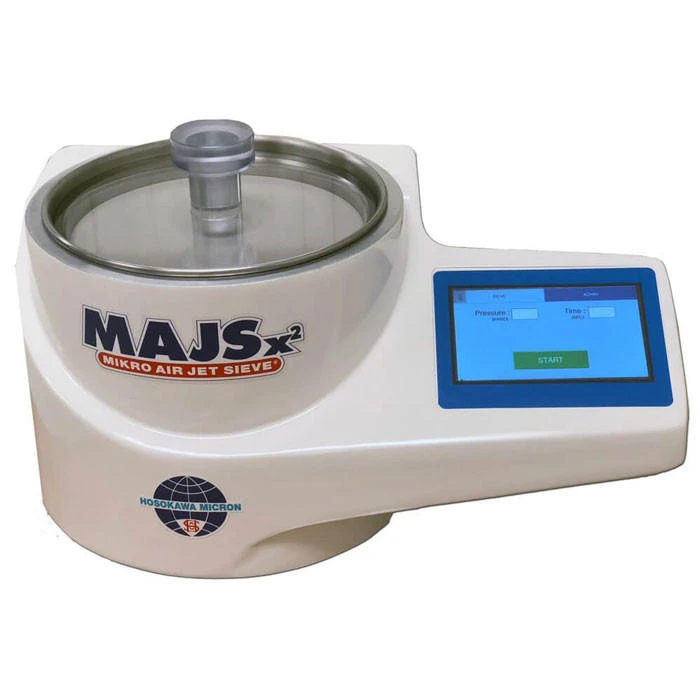
The Basic Mikro Air Jet Sieve for 200mm test sieves is one configuration to review for an approved dry-powder procedure. Confirm the required vacuum system and sieve compatibility before ordering; the instrument does not automatically replace a specified aggregate acceptance method. If the system needs additional fines collection, review the Mikro Air-Jet Cyclone Collector for documented compatibility with the selected setup.
Confirm that your balance suits the procedure’s mass measurements and that you can recover retained material without damaging the mesh. Also check how the manufacturer instructs you to inspect, clean, and maintain the sieve and airflow system.
Certified MTP supplies construction materials testing equipment and laboratory supplies. For a particular air jet application, review the model's documented suitability rather than inferring compatibility from a general equipment category.
Before ordering, compare the product specifications with your material, required sieve apertures, test method, and reporting requirements. Check the documented sieve compatibility, vacuum requirements, and included accessories. Use the equipment for acceptance testing only when the governing specification permits the procedure.
Can an air jet sieve replace ASTM C117 washing?
No—not simply because both procedures address fine material. ASTM C117 determines material finer than 75 µm by washing; an air jet procedure uses dry airflow and suction. Treat the results as distinct unless the governing specification explicitly accepts the alternative procedure.
A comparison study can document how results relate for the materials examined. It does not, by itself, change a contract’s specified method or establish equivalence for every aggregate source.
What should you do if the sieve keeps blinding?
Stop and inspect the specimen condition, loading, mesh cleanliness, and airflow arrangement. Follow the approved procedure for corrective action rather than raising suction or extending the run without a documented basis.
Use only cleaning methods permitted for the sieve and instrument. Forcing lodged particles through the mesh changes the measured fraction and risks damaging the cloth.
What belongs in a defensible test report?
Your report template should identify the sample, tested fraction, dry mass basis, sieve designation, instrument settings, endpoint, and calculation. Record the actual procedure used, not merely the standard associated with the broader project.
State whether the result represents the whole aggregate or a separated fine fraction. That distinction is essential when another engineer uses the result to assess a specification limit or compare production lots.
Air Jet Sieving FAQ
Can I use an air jet sieve for aggregate gradation acceptance testing?
Use an air jet sieve for aggregate gradation acceptance testing only when the governing specification permits the procedure. An instrument’s ability to separate fines does not establish compliance with ASTM C136/C136M or ASTM C117.
What sieve opening corresponds to the No. 200 sieve?
The No. 200 sieve has a nominal opening of 75 µm. Confirm the required sieve designation and documented instrument compatibility before testing.
What sieve opening corresponds to the No. 100 sieve?
The No. 100 sieve has a nominal opening of 150 µm. Selecting that aperture does not establish the specimen size, airflow setting, or endpoint.
How long should I run an air jet sieve?
Run an air jet sieve to the endpoint specified by the approved procedure and instrument instructions. Do not use an arbitrary duration or continue until the result matches an expected grading.
Can I test damp fine aggregate in an air jet sieve?
Prepare the aggregate to the moisture condition required by the procedure before air jet testing. Residual moisture can affect agglomeration and passage through the mesh.
Does one air jet sieve result give a complete aggregate grading?
One air jet sieve result does not give a complete aggregate grading. It describes separation at one aperture for the tested specimen and recorded conditions.
What should I check before selecting an air jet sieve?
Review the documented suitability for your material, sieve apertures, procedure, and reporting purpose. Confirm the required sieve frames, airflow components, accessories, and maintenance instructions for the proposed configuration.
Wrapping Up
A precise balance cannot correct the wrong reporting basis. Before releasing a result, check whether the denominator represents the original aggregate, a selected fine fraction, or material remaining after an earlier separation.
Add that check to your worksheet before expanding the procedure to additional apertures. It prevents a mathematically correct percentage from being assigned to the wrong specimen.