How to Test Sand Quality at Construction Sites for Concrete
Posted by Matt Johnson on Jun 13, 2024
Test sand for concrete by screening it on site, then confirming it in the lab against ASTM C33 or your project specification. Sand (fine aggregate) makes up roughly a quarter to a third of a typical mix, so its grading, cleanliness and soundness directly affect workability, water demand, strength and durability. Field checks flag obvious problems; lab tests decide whether a source is accepted.
- ASTM C33 requires a fine aggregate fineness modulus between 2.3 and 3.1.
- Material finer than the No. 200 sieve is generally limited to 3% for concrete subject to abrasion and 5% for other concrete.
- Field checks screen sand; only lab tests should accept or reject a source.
Why this matters
Sand that is too fine raises water demand and shrinkage; sand carrying clay weakens the paste bond; organic matter delays setting. Each of these shows up later as low strength, cracking or poor finishing.
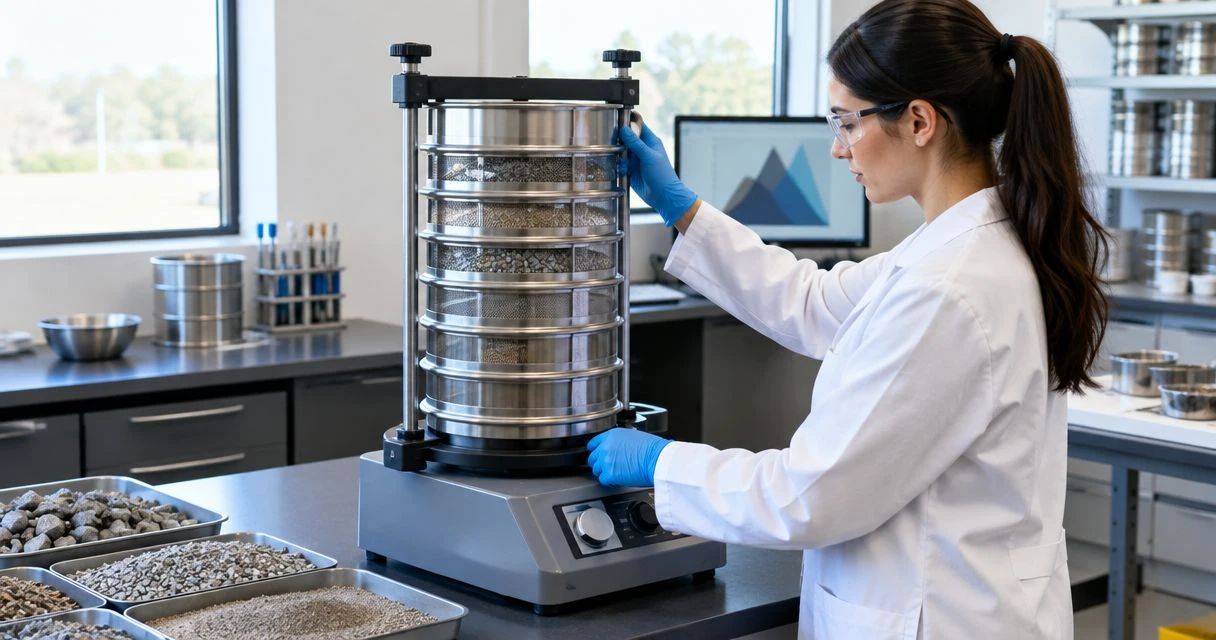
Screen on site, decide in the lab. Grading starts with 8in ASTM sieves and a sieve shaker.
How do you test sand quality for concrete?
- Sample properly. Take samples from several points in the stockpile per ASTM D75, not from the surface or edge.
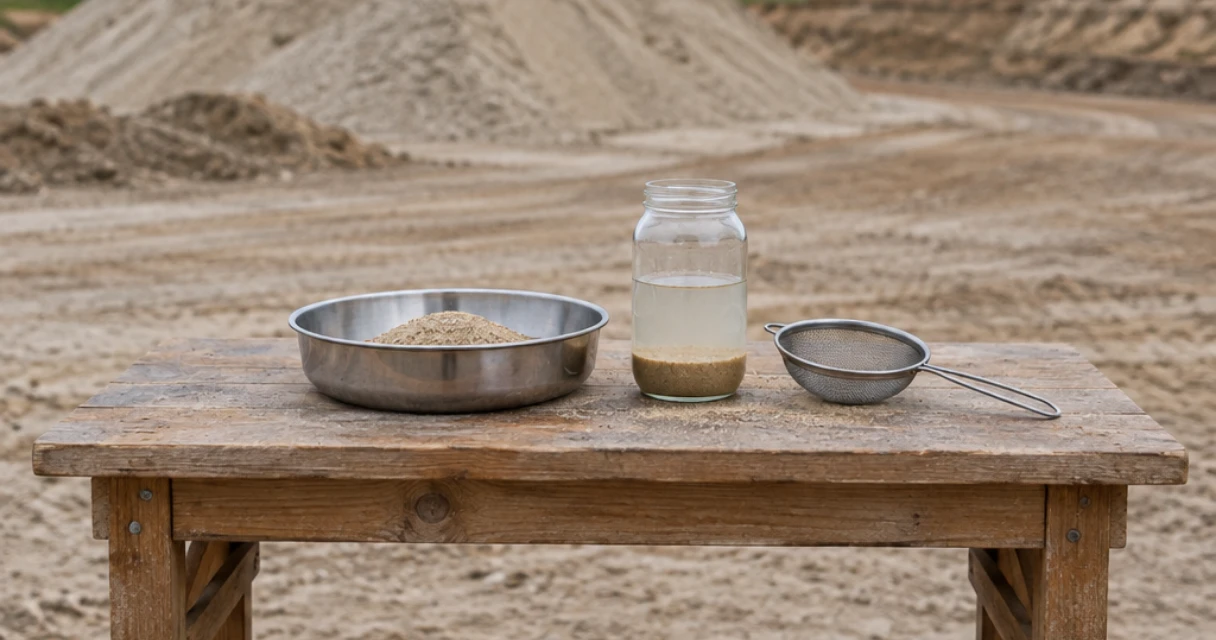
- Run quick field checks. Rub a handful between your palms (a heavy stain or sticky feel suggests clay or silt), run a jar settling check, and look for roots, wood, coal, shells or clay lumps.
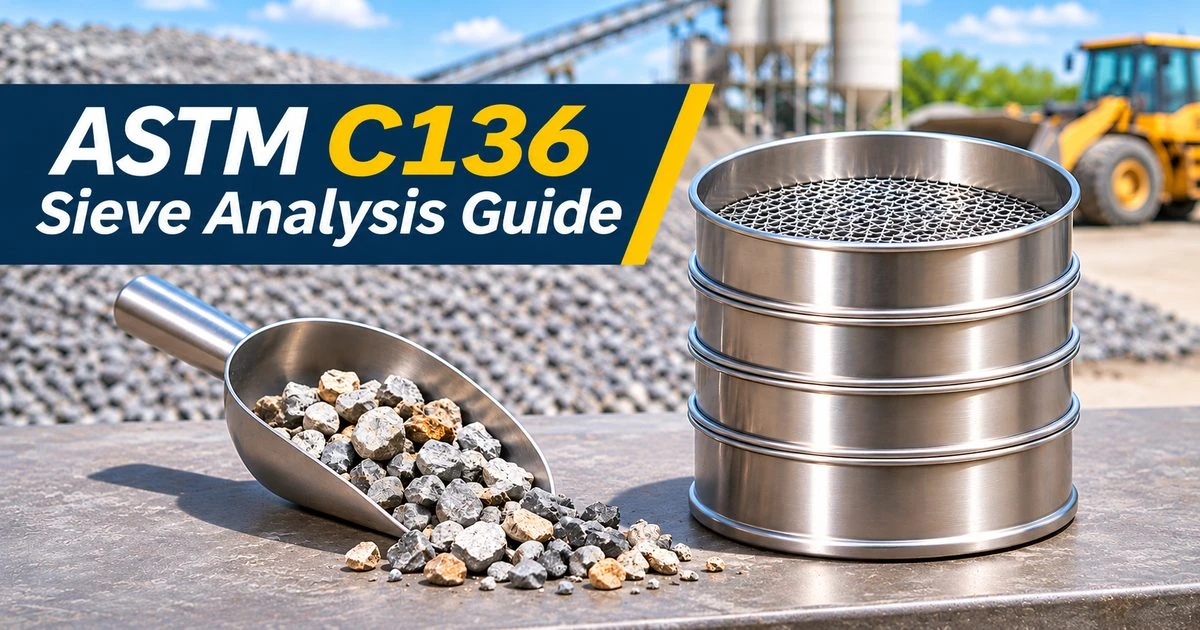
- Test grading and fineness modulus by ASTM C136.
- Test fines by washing over the No. 200 sieve (ASTM C117).
- Test for organic impurities (ASTM C40) and clay-like fines (sand equivalent, ASTM D2419).
- Measure specific gravity and absorption (ASTM C128) for mix design.
- Check durability where required: clay lumps (C142), soundness (C88) and alkali-silica reactivity (C1260 / C1293).
Grading and fineness modulus: the first acceptance test
ASTM C33 sets grading limits from 100% passing the 3/8in sieve down to 0 to 10% passing the No. 100, with a fineness modulus between 2.3 and 3.1. See our guide to the fineness modulus of aggregates.
Best for: every new source and routine QC. The limitation: grading alone does not reveal clay coatings or organics.
Silt and clay: washing over the No. 200 sieve
Wash the sample using wet-wash sieves and measure the loss. C33 generally limits this to 3% for concrete subject to abrasion and 5% for other concrete, with higher limits allowed for manufactured sand when the fines are free of clay.
Best for: quantifying fines that raise water demand. The limitation: it does not distinguish clay from harmless rock dust; the sand equivalent test helps there.
Organic impurities: the color comparison test
Shake the sand with a 3% sodium hydroxide solution and compare the liquid’s color after 24 hours with a standard color plate. Darker than the reference means further testing is needed. Our organic impurities test set includes the bottle and pellets, and the color wheel reference chart gives the comparison.
Best for: screening for organics that delay setting. The limitation: a dark result calls for further testing rather than automatic rejection.
Sand equivalent: separating clay-like fines
The sand equivalent test separates clay-like fines from sand in a graduated cylinder; higher values mean cleaner sand. Use a complete sand equivalent test set.
Best for: judging whether fines are clay or harmless. The limitation: it complements, not replaces, the C117 wash.
Fine aggregate tests compared
| Test | Standard | What it tells you | Equipment |
|---|---|---|---|
| Sieve analysis | ASTM C136 | Grading and fineness modulus | Sieves, balance, shaker |
| Material finer than No. 200 | ASTM C117 | Silt and clay content by washing | Wash sieve, oven, balance |
| Organic impurities | ASTM C40 | Harmful organic matter by color | Test bottle, NaOH, color plate |
| Sand equivalent | ASTM D2419 | Proportion of clay-like fines | Sand equivalent set |
| Specific gravity and absorption | ASTM C128 | Values for mix design | Specific gravity equipment |
| Clay lumps and friable particles | ASTM C142 | Weak or clay particles | Sieves, balance |
| Soundness | ASTM C88 | Resistance to weathering | Sulfate solution, sieves |
| Alkali-silica reactivity | ASTM C1260 / C1293 | Risk of ASR expansion | Specialist lab testing |
How does sand quality affect concrete?
- Too fine: higher water demand, more shrinkage, lower strength at the same cement content.
- Too coarse or gap graded: harsh mixes, bleeding and poor finishing.
- Clay and silt: higher water demand, weaker paste bond and more cracking.
- Organics: delayed setting and lower early strength.
Can beach sand be used in concrete?
Unwashed beach sand is usually avoided because of chlorides that corrode reinforcement, shell content and uniform grading. Any source must pass the project specification.
FAQ
How often should sand be tested?
Test a new source fully before use, then run grading and fines tests at the frequency your specification or QC plan sets, and whenever the material looks different.
Can beach sand be used in concrete?
Unwashed beach sand is usually avoided because of chlorides, shell content and uniform grading. Any source must pass the project specification.
What fineness modulus does ASTM C33 require?
Between 2.3 and 3.1 for fine aggregate.
Is a jar settling test enough to accept sand?
No. It is a screening check only. Acceptance rests on laboratory tests against ASTM C33 or the project specification.
What does a dark organic impurities result mean?
A solution darker than the reference color means further testing is needed to decide whether the organics affect the concrete.
Wrapping Up
Screen the stockpile, then prove the sand in the lab. Grading, fines, organics and specific gravity cover most acceptance decisions; durability tests follow where the specification requires them.
Certified Material Testing Products supplies ASTM sieves, wash sieves, organic impurities sets and sand equivalent sets for fine aggregate testing. Read more in our ASTM C33 guide.
Topics: Fine Aggregate; Sand Testing; Concrete Testing.