Fahrenheit to Celsius Chart: Conversion Table and Formula
Posted by Matt Johnson on Nov 26, 2026
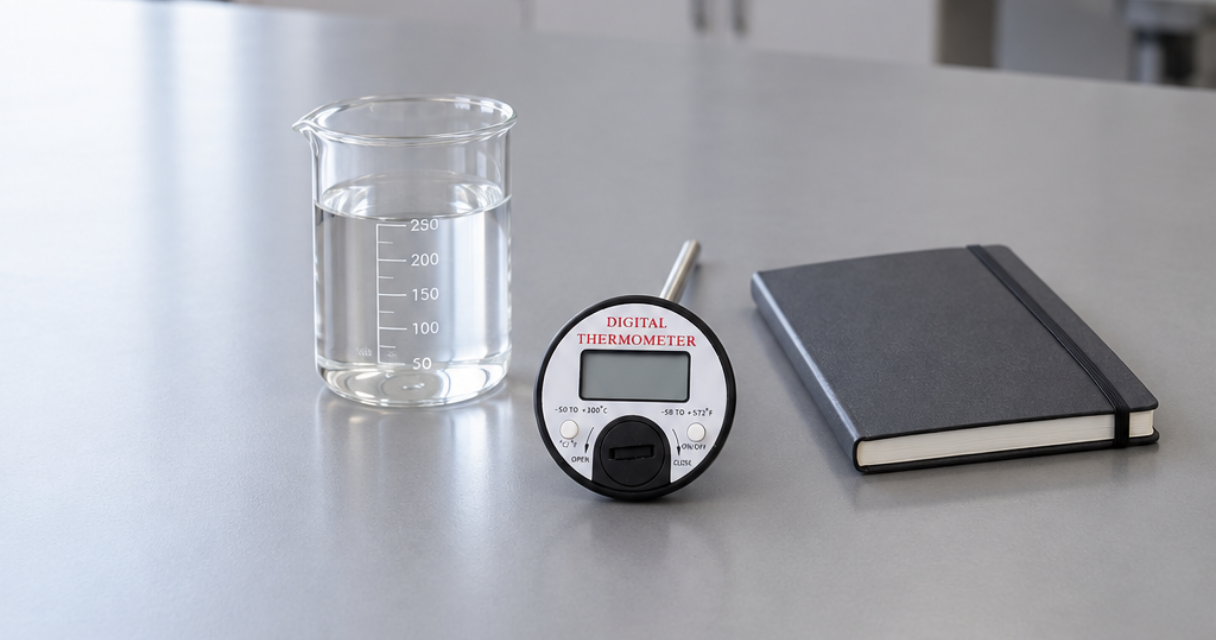
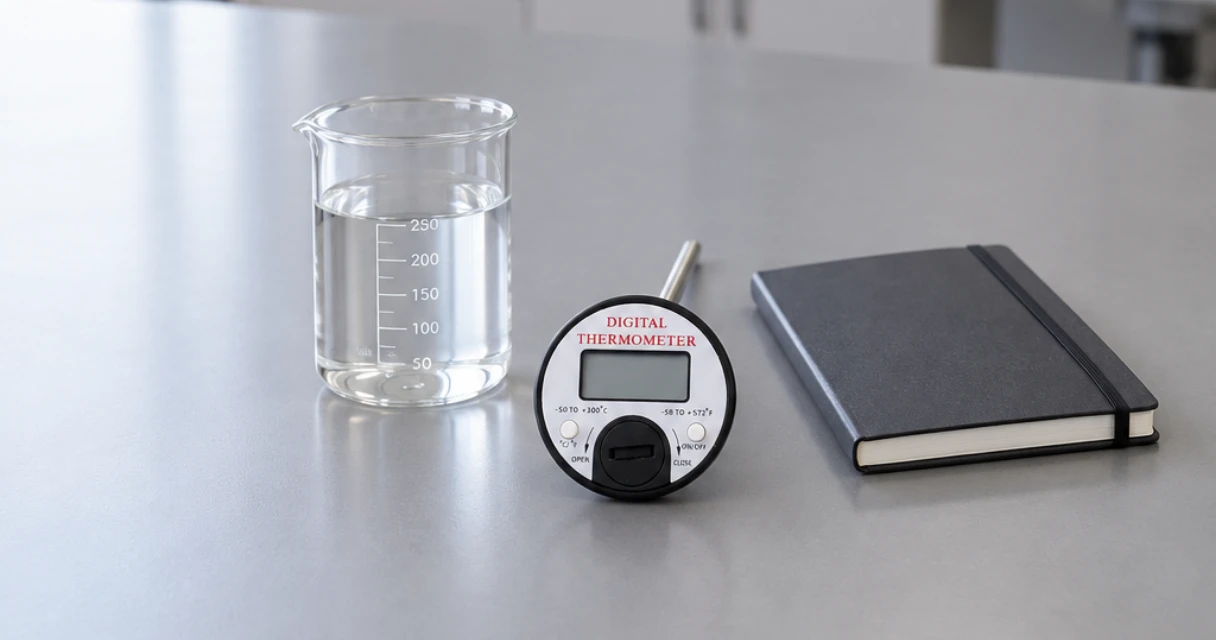
To convert Fahrenheit to Celsius, subtract 32 and multiply by 5/9: °C = (°F − 32) × 5/9. For example, 78 °F is 25.6 °C and 900 °F is 482.2 °C. The chart below lists common temperatures from −40 °F to 1,800 °F, including the values that come up most in materials testing. To get readings you can trust in the first place, use a calibrated thermometer that reads in the unit your test method uses.
Fahrenheit to Celsius chart
Cold to room temperature
| °F | °C | Reference |
|---|---|---|
| −40 | −40.0 | The two scales are equal |
| −20 | −28.9 | |
| 0 | −17.8 | Zero on the Fahrenheit scale |
| 10 | −12.2 | |
| 20 | −6.7 | |
| 32 | 0.0 | Water freezes |
| 40 | 4.4 | |
| 50 | 10.0 | |
| 60 | 15.6 | |
| 68 | 20.0 | Common reference temperature for lab glassware and hydrometers |
| 70 | 21.1 | |
| 72 | 22.2 | |
| 73.5 | 23.1 | Standard curing temperature for concrete cylinders (73.5 ± 3.5 °F) |
| 75 | 23.9 | |
| 77 | 25.0 | |
| 78 | 25.6 | |
| 80 | 26.7 | |
| 90 | 32.2 |
Body and warm temperatures
| °F | °C | Reference |
|---|---|---|
| 98.6 | 37.0 | Traditional average body temperature |
| 99.4 | 37.4 | |
| 100 | 37.8 | |
| 100.4 | 38.0 | Commonly used fever threshold |
| 110 | 43.3 | |
| 120 | 48.9 | |
| 140 | 60.0 | |
| 160 | 71.1 | |
| 180 | 82.2 | |
| 200 | 93.3 | |
| 212 | 100.0 | Water boils at sea level |
Lab, oven and furnace temperatures
| °F | °C | Reference |
|---|---|---|
| 230 | 110.0 | Drying soil and aggregate to constant mass (110 ± 5 °C) |
| 250 | 121.1 | |
| 275 | 135.0 | |
| 300 | 148.9 | |
| 325 | 162.8 | |
| 350 | 176.7 | |
| 375 | 190.6 | |
| 400 | 204.4 | |
| 450 | 232.2 | |
| 500 | 260.0 | |
| 600 | 315.6 | |
| 700 | 371.1 | |
| 800 | 426.7 | |
| 900 | 482.2 | |
| 1,000 | 537.8 | |
| 1,200 | 648.9 | |
| 1,500 | 815.6 | |
| 1,800 | 982.2 |
Values are rounded to one decimal place. Always check the exact temperature and tolerance in the test method you are running.
How to convert Fahrenheit to Celsius
- Subtract 32 from the Fahrenheit temperature.
- Multiply by 5.
- Divide by 9. Dividing by 1.8 instead of multiplying by 5/9 gives the same answer.
Example, 78 °F: 78 − 32 = 46; 46 × 5 = 230; 230 ÷ 9 = 25.56 °C.
Example, 99.4 °F: 99.4 − 32 = 67.4; 67.4 × 5/9 = 37.44 °C.
Example, 900 °F: 900 − 32 = 868; 868 × 5/9 = 482.22 °C.
To go the other way, multiply Celsius by 9/5 (or 1.8) and add 32: °F = °C × 1.8 + 32. For example, 110 °C × 1.8 + 32 = 230 °F.
Why the formula works
Water freezes at 32 °F and 0 °C, and boils at 212 °F and 100 °C at sea level. That puts 180 Fahrenheit degrees between the two points but only 100 Celsius degrees, so one Celsius degree equals 1.8 Fahrenheit degrees. Subtracting 32 lines up the two zero points before you scale.
Mistakes to avoid
- Multiplying before subtracting 32. The order matters.
- Using rough shortcuts for test work. “Subtract 30 and halve” can be several degrees off. It is fine for weather, not for a test method.
- Converting temperature differences with the full formula. A tolerance or change of temperature is converted by the factor alone. A ±9 °F tolerance is ±5 °C, not −12.8 °C.
- Rounding too early. Round only the final answer.
Kelvin and Rankine
Absolute scales start at absolute zero, the lowest possible temperature: 0 K = −273.15 °C = −459.67 °F.
- Kelvin: K = °C + 273.15. 900 °F is 482.22 °C, or 755.37 K.
- Rankine: °R = °F + 459.67. 900 °F is 1,359.67 °R. Rankine is used mainly in U.S. engineering calculations.
Temperatures in materials testing
Many test methods set a temperature and a tolerance, and a few degrees of error can change the result. A drying oven running cool leaves moisture in a soil sample, and curing water that is too warm speeds up cylinder strength gain. Some common examples:
- Drying to constant mass: soil and aggregate tests commonly dry samples at 110 ± 5 °C (230 ± 9 °F) in a laboratory oven.
- Curing concrete cylinders: standard moist curing holds 73.5 ± 3.5 °F (23.0 ± 2.0 °C) in a curing box or tank.
- Fresh concrete temperature: measured on site with a calibrated digital pocket thermometer or dial thermometer.
- Asphalt mixing and compaction: mix temperatures are checked with probe and asphalt thermometers.
- Ignition and ash tests: high-temperature work is done in a muffle furnace and monitored with thermocouple probes.
Where a record is required, a temperature data logger documents the conditions over time.
Choosing a thermometer
- Range: pick a thermometer whose range covers the test with margin, from freezer checks to furnace work.
- Resolution and accuracy: match them to the tolerance in your test method. A ±2 °C tolerance needs a thermometer much better than ±2 °C.
- Scale: many digital thermometers switch between °F and °C, which removes conversion errors.
- Type: mercury-free liquid-in-glass thermometers for lab baths, infrared thermometers for quick surface checks, and thermocouples for high heat.
- Calibration: verify thermometers against a reference at the intervals your quality program sets.
Freezing point depression
Dissolving a substance in water lowers its freezing point below 0 °C (32 °F). This is why road salt melts ice and why antifreeze protects an engine. For dilute solutions the drop is:
ΔTf = i × Kf × m
- ΔTf is the drop in freezing point, in °C.
- i is the van’t Hoff factor, the number of particles each unit of solute forms in solution. Ideally i = 1 for sugar, 2 for sodium chloride (NaCl) and 3 for calcium chloride (CaCl2).
- Kf is the freezing point depression constant of the solvent. For water it is 1.86 °C·kg/mol.
- m is molality: moles of solute per kilogram of solvent.
Example: 29 g of NaCl (molar mass 58.44 g/mol) in 1 kg of water is 0.496 mol/kg. ΔTf = 2 × 1.86 × 0.496 ≈ 1.85 °C, so the solution freezes at about −1.85 °C (28.7 °F). Note that a drop of 1.85 Celsius degrees is a drop of 3.3 Fahrenheit degrees, because a temperature change converts by the factor 1.8 alone.
The more solute you add, the lower the freezing point. The equation assumes ideal, dilute behavior. At high concentrations, real ions interact and the measured drop is smaller than the formula predicts. Accurate work needs a precise analytical balance to weigh the solute and a thermometer with fine resolution near 0 °C.
Frequently asked questions
What is 78 °F in Celsius?
78 °F is 25.6 °C. 77 °F is exactly 25 °C.
What is 99.4 °F in Celsius?
99.4 °F is 37.4 °C, slightly above the traditional 98.6 °F (37 °C) body temperature.
What is 900 °F in Celsius?
900 °F is 482.2 °C, or 755.4 K.
Is 100 °F the same as 40 °C?
No. 100 °F is 37.8 °C, and 40 °C is 104 °F.
At what temperature are Fahrenheit and Celsius equal?
At −40. −40 °F is exactly −40 °C.
How much does salt lower the freezing point of water?
For a dilute solution, about 3.7 °C per mole of NaCl per kilogram of water in the ideal case. Real solutions fall somewhat short of this at higher concentrations.