Understanding ASTM C33 Standards for Concrete Aggregates
Posted by Matt Johnson on Jul 02, 2024
ASTM C33 is the standard specification for concrete aggregates in the United States. It sets grading limits, allowable amounts of harmful materials and durability requirements for the fine aggregate (sand) and coarse aggregate (gravel or crushed stone) used in normal-weight concrete. Project specifications usually reference C33 directly, so a producer’s sand or stone must pass its tests before it goes into the mix.
- Fine aggregate must have a fineness modulus between 2.3 and 3.1, with no more than 45% between any two consecutive sieves.
- Coarse aggregate is graded by size number (such as No. 57 or No. 67) and limited by class designation.
- Compliance rests on standard tests: C136 grading, C117 fines, C40 organics, C142, C88 and C131.
Why this matters
Aggregate makes up most of a concrete mix. Grading outside C33 limits raises water demand or makes mixes harsh; clay, organics and unsound particles weaken durability. A source that fails C33 can hold up a pour or a payment.
Proving C33 compliance starts with sound sampling and sieving. See all aggregate testing equipment.
How do you check aggregate against ASTM C33?
- Sample by ASTM D75 and reduce with a sample splitter per C702.
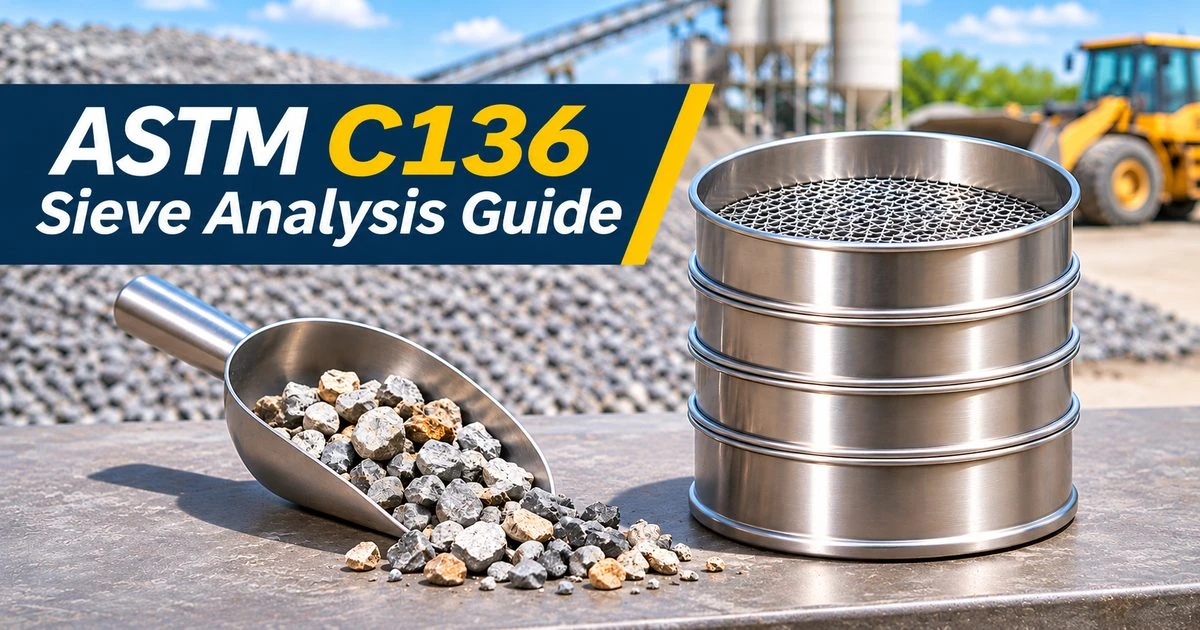
- Grade by ASTM C136 with the sieves C33 lists, using a sieve shaker.
- Wash fines by ASTM C117.
- Check organics in sand by ASTM C40.
- Check deleterious materials and durability: clay lumps (C142), soundness (C88), abrasion (C131 / C535) and alkali-silica reactivity (C1260, C1293).
- Compare results with the C33 limits and your project specification.
Fine aggregate: grading limits and fineness modulus
| Sieve | Percent passing |
|---|---|
| 3/8in (9.5 mm) | 100 |
| No. 4 (4.75 mm) | 95 to 100 |
| No. 8 (2.36 mm) | 80 to 100 |
| No. 16 (1.18 mm) | 50 to 85 |
| No. 30 (600 µm) | 25 to 60 |
| No. 50 (300 µm) | 5 to 30 |
| No. 100 (150 µm) | 0 to 10 |
No more than 45% may pass any one sieve and be retained on the next, and the fineness modulus must be between 2.3 and 3.1. Material finer than the No. 200 sieve is generally limited to 3% for concrete subject to abrasion and 5% for other concrete, with allowances for manufactured sand. C33 permits some departures when the producer shows the concrete performs acceptably, so check your project specification and the current edition.
Other fine aggregate checks include organic impurities (C40) with an organic impurities test set, clay lumps and friable particles (C142) and soundness (C88) where required.
Coarse aggregate: size numbers and class designations
Coarse aggregate grading is specified by size number, each with its own grading table in C33:
| Size No. | Nominal size | Best for | Testing note |
|---|---|---|---|
| 57 | 1in to No. 4 | General structural concrete, slabs, paving | Use 12in sieves to avoid overloading |
| 67 | 3/4in to No. 4 | Thinner sections, congested reinforcement | Check the No. 4 fraction closely |
| 8 | 3/8in to No. 8 | Pea gravel mixes, thin overlays | 8in sieves usually suffice |
| 467 | 1-1/2in to No. 4 | Mass concrete, footings | Large samples; 12in sieves recommended |
C33 also assigns a class designation, such as 1S to 5S or 1M to 4M, based on weathering severity and construction type. The class limits clay lumps, chert, coal and lignite, abrasion loss and soundness; severe-weathering exposed concrete such as pavements and bridge decks carries the strictest limits. Test coarse samples with 12in diameter sieves or ASTM aggregate sieves.
C33 compliance tests compared
| Property | Test method | Applies to | Key equipment |
|---|---|---|---|
| Sampling | ASTM D75, reduced by C702 | Fine and coarse | Sample splitter |
| Grading | ASTM C136 | Fine and coarse | Sieves, shaker, balance |
| Finer than No. 200 | ASTM C117 | Fine and coarse | Wash sieve, oven |
| Organic impurities | ASTM C40 | Fine | Test bottle, color plate |
| Clay lumps and friable particles | ASTM C142 | Fine and coarse | Sieves, balance |
| Soundness | ASTM C88 | Fine and coarse | Sulfate solution, sieves |
| Abrasion | ASTM C131 / C535 | Coarse | Los Angeles machine |
| Alkali-silica reactivity | ASTM C1260, C1293 | Fine and coarse | Specialist lab testing |
Why C33 results vary
- Sampling: stockpile segregation skews grading if samples are not taken per D75.
- Splitting: poor reduction changes the test portion.
- Sieve loading: overloaded coarse sieves retain material that should pass.
- Washing: skipping C117 under-reports fines.
- Source variability: recycled aggregate often has higher absorption and more fines.
Can recycled aggregate meet ASTM C33?
Yes. C33 covers natural and manufactured aggregates, and recycled concrete aggregate can be used when it meets the same requirements. Test it as thoroughly as any new source.
FAQ
What is ASTM C33 sand?
Concrete sand that meets the C33 fine aggregate grading, fineness modulus and cleanliness requirements.
Is No. 57 stone a C33 gradation?
Yes. Size No. 57 is one of the C33 coarse aggregate gradings, nominally 1in to No. 4.
What fineness modulus does C33 require?
Between 2.3 and 3.1 for fine aggregate.
What is a C33 class designation?
A code such as 1S to 5S or 1M to 4M, based on weathering region and construction type, that sets limits on deleterious materials, abrasion and soundness for coarse aggregate.
Which test checks aggregate grading for C33?
ASTM C136 sieve analysis. See our ASTM C136 sieve analysis guide.
Wrapping Up
Sample right, sieve right and compare against the current edition. Most C33 failures trace back to sampling, overloaded sieves or skipped washing rather than the aggregate itself.
Certified Material Testing Products supplies sample splitters, ASTM aggregate sieves, sieve shakers and organic impurities sets for C33 testing. Read our guide on testing sand quality for concrete.
Topics: Aggregates; ASTM C33; Concrete Testing.