ASTM D2487: Navigating the Unified Soil Classification System
Posted by Matt Johnson on Jul 21, 2024
ASTM D2487 classifies soils for engineering purposes using the Unified Soil Classification System (USCS). It places a soil into a group with a two-letter symbol such as GW, SM or CL, based on two laboratory results: the particle-size distribution and the Atterberg limits. To classify correctly, you need accurate sieve, Atterberg and oven data before you open the flow chart.
- The No. 200 sieve splits coarse-grained soils (more than 50% retained) from fine-grained soils (50% or more passing).
- Coarse soils are named by gradation (Cu and Cc) and fines content; fine soils by the plasticity chart and the A-line.
- D2487 is the lab classification; ASTM D2488 is the visual-manual field description.
Why this matters
The USCS group is a quick guide to how a soil will behave as a foundation, fill or subgrade. Well-graded gravels and sands usually drain well and compact to high density; fat clays (CH) can swell and shrink with moisture; organic soils and peat are generally unsuitable under structures.
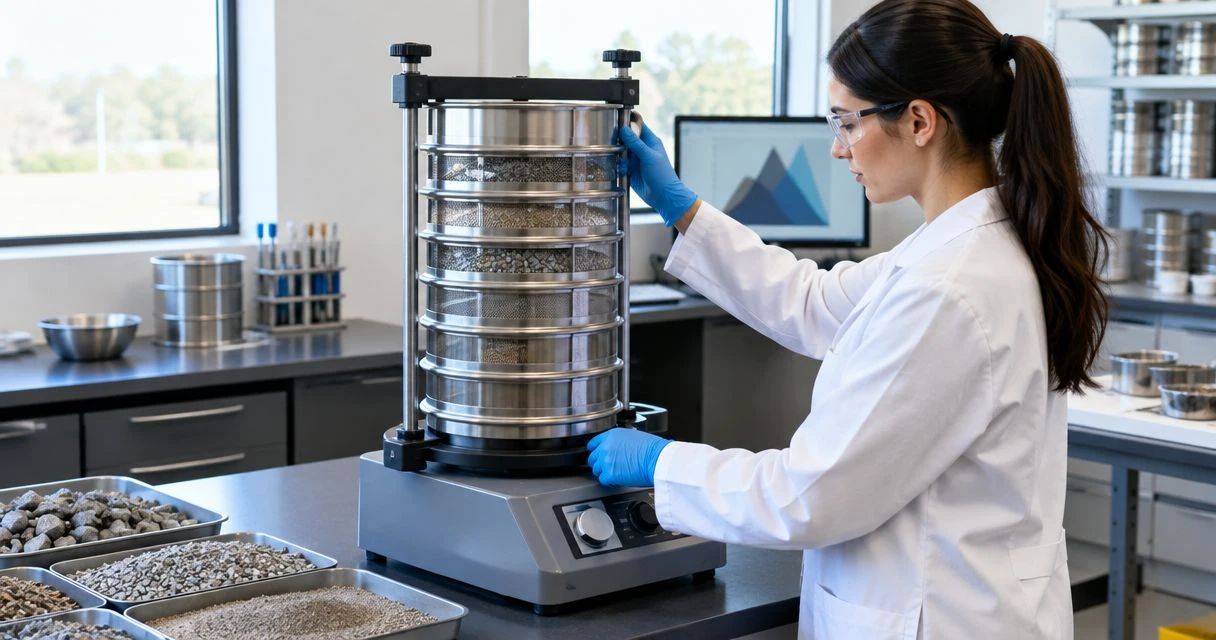
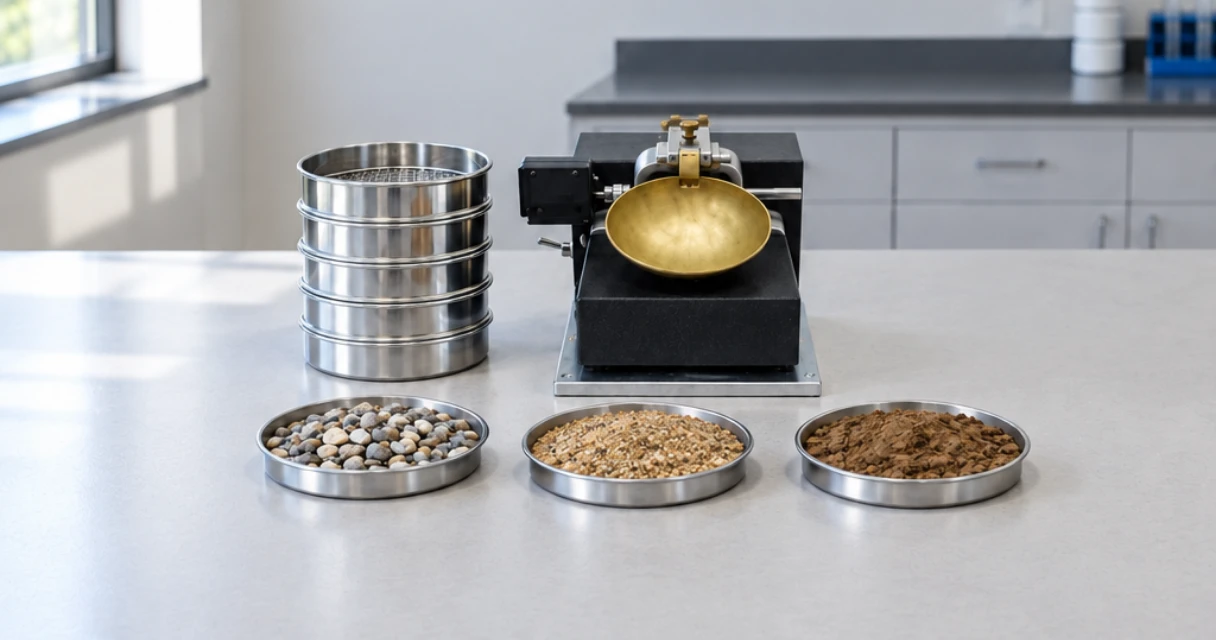
A wrong group symbol sends the project down the wrong testing path. Classification depends on ASTM test sieves through the No. 200 and Atterberg limits test equipment.
What does ASTM D2487 cover?
D2487 applies to natural soils with particles smaller than 3in (75 mm); cobbles and boulders are noted separately. The classification is made in the laboratory. For field descriptions without lab data, ASTM D2488 uses the same group names but is less precise.
Which lab tests feed the classification?
- Particle-size distribution (ASTM D6913). Sieve analysis finds the percent of gravel, sand and fines. See our guide to ASTM D6913.
- Atterberg limits (ASTM D4318). Liquid limit (LL) and plastic limit (PL) give the plasticity index, PI = LL − PL. A hand-operated liquid limit machine is the standard tool.
- Organic check. A second liquid limit on an oven-dried portion identifies organic soils.
- Supporting equipment. A drying oven and a balance suited to the specimen size.
Step 1: Is the soil coarse-grained or fine-grained?
- Coarse-grained: more than 50% retained on the No. 200 (75 µm) sieve. First letter G (gravel) or S (sand).
- Fine-grained: 50% or more passes the No. 200 sieve. First letter M (silt), C (clay) or O (organic).
- Highly organic soils (peat): symbol PT, identified by appearance and odor.
Step 2: Coarse-grained soils use gradation and fines content
A soil is a gravel if more than half of its coarse fraction is retained on the No. 4 (4.75 mm) sieve, and a sand if half or more passes. The second letter depends on fines content:
| Fines (passing No. 200) | Second letter | Example symbols |
|---|---|---|
| Less than 5% | W (well graded) or P (poorly graded) | GW, GP, SW, SP |
| 5% to 12% | Dual symbol | GW-GM, SP-SC |
| More than 12% | M (silty fines) or C (clayey fines) | GM, GC, SM, SC |
Gradation uses the coefficient of uniformity, Cu = D60/D10, and the coefficient of curvature, Cc = (D30)²/(D10 × D60). A gravel is well graded when Cu ≥ 4 and 1 ≤ Cc ≤ 3; a sand when Cu ≥ 6 and 1 ≤ Cc ≤ 3. Our graph for sieve analysis article shows how to read D10, D30 and D60.
Step 3: Fine-grained soils use the plasticity chart
- The A-line, PI = 0.73 (LL − 20), separates clays (above) from silts (below).
- LL below 50 means low plasticity (L); LL of 50 or more means high plasticity (H). That gives CL, ML, CH and MH.
- A soil in the hatched zone (PI between 4 and 7, above the A-line) is CL-ML.
- If the oven-dried LL is less than 75% of the undried value, the soil is organic: OL or OH.
USCS group symbols at a glance
| Symbol | Group name (simplified) | Typical behavior | What to check next |
|---|---|---|---|
| GW / GP | Well-graded / poorly graded gravel | Drains well; compacts to high density when well graded | Compaction and gradation control |
| GM / GC | Silty / clayey gravel | Fines reduce drainage | Fines content and plasticity |
| SW / SP | Well-graded / poorly graded sand | Free-draining | Compaction and density |
| SM / SC | Silty / clayey sand | Moisture-sensitive | Moisture-density relationship |
| ML / CL | Silt / lean clay | Low plasticity fines | Strength and compaction testing |
| MH / CH | Elastic silt / fat clay | CH can swell and shrink; weak when wet | Swell, consolidation and strength |
| OL / OH / PT | Organic silt or clay / peat | Generally unsuitable under structures | Engineering review |
D2487 also adds descriptive words such as “with sand” or “gravelly” when 15% or more of a secondary fraction is present. Use the flow charts in the current edition for full group names.
Why soil classification results vary
- Sample representativeness: a split that is not representative shifts the fines percentage.
- Washing: dry sieving alone under-reports material finer than the No. 200.
- Sieve condition: worn or damaged mesh changes openings.
- Atterberg technique: liquid limit device calibration and operator consistency affect LL and PI.
- Drying temperature: overheating can alter organic or clay soils.
Does the USCS group replace other soil tests?
No. The group does not replace strength, compaction or consolidation testing, but it tells you which of those tests the soil needs.
FAQ
What is the difference between ASTM D2487 and D2488?
D2487 uses lab test results and is the formal classification. D2488 is a visual-manual description made in the field or from samples without lab data.
Is USCS the same as AASHTO classification?
No. AASHTO M 145 is a separate system used mainly for highway subgrades. The two use similar tests but different groups and boundaries.
What equipment do I need for USCS classification?
Test sieves through the No. 200, a balance, a drying oven and Atterberg limits equipment. A soil classification set helps with field descriptions.
When does a soil get a dual symbol?
A coarse-grained soil with 5% to 12% fines gets a dual symbol such as GW-GM or SP-SC. A fine-grained soil plotting in the hatched CL-ML zone also gets a dual symbol.
How do you tell an organic soil?
Run a second liquid limit on an oven-dried portion. If it is less than 75% of the undried liquid limit, the soil is classified as organic (OL or OH).
Wrapping Up
Classification is only as reliable as the sieve and Atterberg data behind it. Wash through the No. 200, keep sieves in good condition and run the liquid limit consistently before applying the chart.
Certified Material Testing Products supplies the sieves, liquid limit devices, ovens and soil classification sets labs use for USCS work. Browse all our soil testing equipment.
Topics: Soil Testing; Soil Classification; USCS.