Test Tube Brush: Understanding Function and Uses
Posted by Matt Johnson on Aug 06, 2024
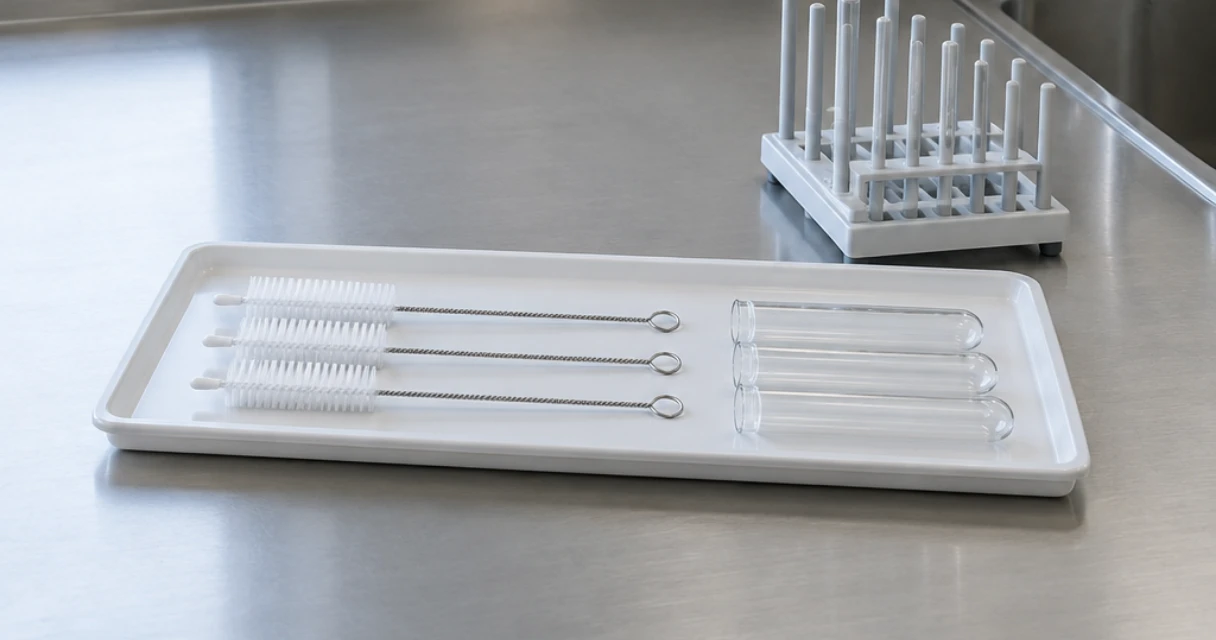
Choose a test tube brush by diameter, bristle material and handle length. A test tube brush is a twisted-wire brush with bristles set around a narrow head, made to scrub the inside of test tubes, centrifuge tubes, graduated cylinders and other narrow glassware. Clean glassware matters: residue from the last test can contaminate the next sample, and grease on the walls throws off volume readings.
- Pick a brush slightly wider than the tube’s inside diameter so the bristles press against the wall.
- Nylon suits most routine cleaning; natural bristles suit delicate glassware.
- Clean glass sheets water evenly; beads or droplets mean grease remains.
Why this matters
Contaminated glassware carries residue into the next test, and a greasy cylinder or pipette delivers the wrong volume. A brush that is too small slides past residue; one with exposed wire scratches the glass.
The right brush cleans without damaging calibrated glassware. Browse our test tubes and accessories.
How do you choose a test tube brush?
- Match the diameter. Choose a brush slightly wider than the inside of the tube. Too large is hard to insert and wears quickly.
- Choose the bristles. Nylon for durability and chemical resistance; natural (hog hair) for gentle scrubbing.
- Check the tip. A fan or tufted end reaches the rounded bottom; a protected wire tip reduces the risk of scratching or cracking glass.
- Check the handle. Longer handles suit cylinders and deep flasks.
Nylon brushes: durable for routine cleaning
Nylon bristles are durable, chemical resistant and hold their shape when wet. Sizes include the nylon 1/2in brush, nylon 3/4in brush and nylon 1-1/2in brush, each in 12-packs.
Best for: most routine cleaning with detergent. The limitation: stiffer than natural bristles on delicate glassware.
Natural-bristle brushes: gentle on delicate glassware
Natural (hog hair) bristles are softer and hold water and detergent well. Options include the natural 3/4in brush and the natural 1in brush.
Best for: delicate glassware and gentle scrubbing. The limitation: less durable than nylon under heavy use.
Test tube brushes compared
| Brush | Best for | Practical advantage | Limitation to manage |
|---|---|---|---|
| Nylon, 1/2in | Small test tubes | Durable, chemical resistant | Too small for larger tubes |
| Nylon, 3/4in | Standard tubes and small cylinders | Holds shape when wet | Check fit against inside diameter |
| Nylon, 1-1/2in | Larger tubes and cylinders | Covers wider walls | Hard to insert in narrow glassware |
| Natural, 3/4in or 1in | Delicate glassware | Soft; holds detergent well | Wears faster than nylon |
Why cleaning results vary
- Brush fit: an undersized brush misses residue on the walls.
- Timing: residue left to dry is harder to remove.
- Detergent: a lab detergent removes grease that water alone leaves behind.
- Rinsing: a final distilled or deionized rinse prevents water spots.
- Cross-contamination: shared brushes carry chemicals between glassware.
How do you clean test tubes with a brush?
- Rinse out loose residue with tap water right after use.
- Wet the brush and apply a lab detergent.
- Insert the brush, twist it and move it up and down the full length, working the tip into the bottom.
- Rinse several times with tap water, then finish with distilled or deionized water.
- Check that water sheets evenly off the glass.
- Dry upside down on a rack or in a drying oven, except volumetric glassware, which should not be heated.
How do you avoid damaging glassware?
- No abrasives on volumetric glassware: scratches can change the calibrated volume of flasks, pipettes and burettes.
- No forcing: use a smaller brush rather than forcing one into a tube.
- Replace damaged brushes: exposed or bent wire scratches glass.
- Use the right brush for sieves: sieve brushes are made not to stretch mesh, and fine sieves can go in an ultrasonic cleaner.
FAQ
What size test tube brush do I need?
Choose a brush slightly larger than the tube’s inside diameter. For a typical 16 mm tube, a 1/2in to 3/4in brush works well.
Can a test tube brush clean graduated cylinders?
Yes, if the diameter matches and the handle is long enough to reach the bottom.
Nylon or natural bristles?
Nylon for most routine cleaning; natural bristles for delicate glassware and gentle scrubbing.
How do I know glassware is clean?
Water should sheet evenly off clean glass. Beads or droplets mean grease remains.
When should I replace a test tube brush?
When the bristles flatten or fall out, or when wire becomes exposed or bent.
Wrapping Up
Fit the brush to the tube and protect calibrated glass. Clean promptly, rinse with distilled water and keep separate brushes for different chemicals.
Certified Material Testing Products stocks nylon and natural-bristle test tube brushes in 12-packs, plus sieve brushes and labware. Browse our labware.
Topics: Lab Equipment; Lab Cleaning; Test Tubes.