Tamping Rod for Concrete: How to Choose the Right One
Posted by Matt Johnson on Aug 06, 2024
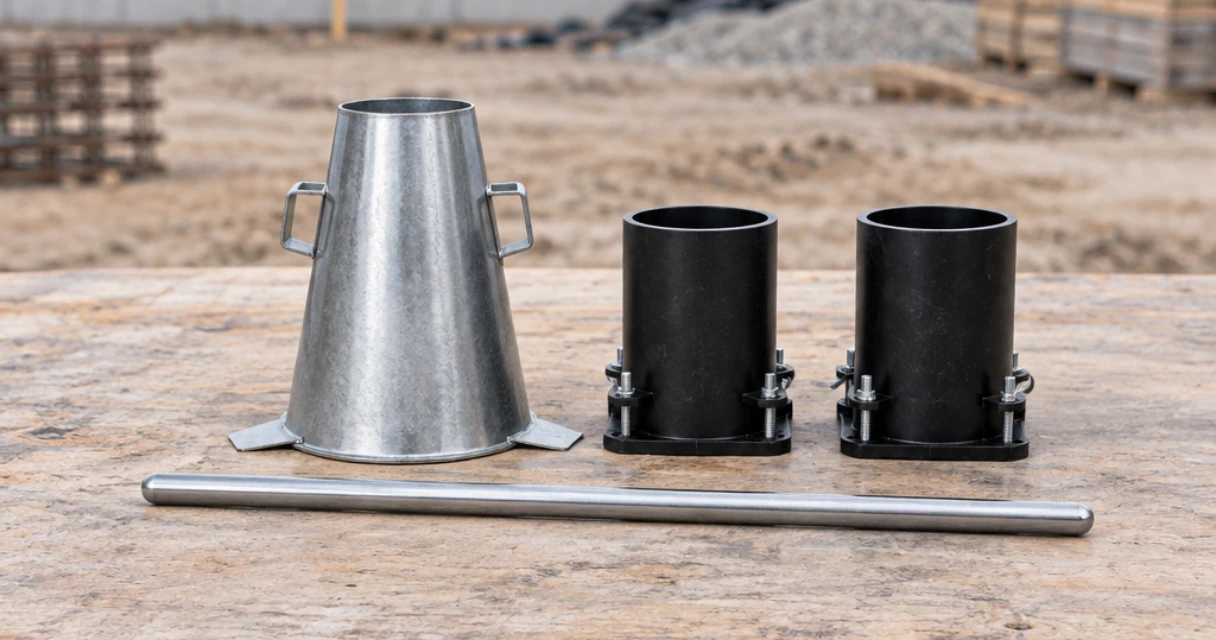
Choose a tamping rod by the test and mold it will be used in: 5/8in (16 mm) diameter for slump, 6 × 12in cylinders, unit weight and pressure air tests, and 3/8in (10 mm) for 4 × 8in cylinders. A tamping rod is a straight, round steel rod with a hemispherical tip that consolidates fresh concrete, and ASTM methods specify its size because consolidation affects slump, density, air content and cylinder strength.
- Use a 5/8in rod for slump, 6 × 12in cylinders, unit weight and air tests; use a 3/8in rod for 4 × 8in cylinders.
- The tip must be hemispherical and the same diameter as the rod; rebar does not qualify.
- Stainless steel resists rust and keeps a smooth surface that concrete does not stick to.
Why this matters
A 5/8in rod in a 4in mold over-consolidates and damages the specimen; a 3/8in rod in a 6in mold under-consolidates. Either can push cylinder strength, slump or air results off and put a pour in question.
The wrong rod changes the result before the test starts. See complete kits in our concrete slump test category.
Which tamping rod does each test need?
| Test | Standard | Rod diameter | Rodding |
|---|---|---|---|
| Slump | ASTM C143 | 5/8in (16 mm) | 3 layers, 25 strokes each |
| 6 × 12in cylinders | ASTM C31 | 5/8in (16 mm) | 3 layers, 25 strokes each |
| 4 × 8in cylinders | ASTM C31 | 3/8in (10 mm) | 2 layers, 25 strokes each |
| Density (unit weight) | ASTM C138 | 5/8in (16 mm) | 3 layers; strokes depend on measure size |
| Air content, pressure method | ASTM C231 | 5/8in (16 mm) | 3 layers, 25 strokes each |
ASTM C31 sets a rod length for each cylinder size. Always check the current edition of the standard your project uses.
How do you choose the right tamping rod?
- Match the diameter to the test and mold size using the table above.
- Set the length. The rod must reach through the layer into the one below without being hard to control: 24in suits slump cones and 6in molds; 12in to 18in suits 4in molds.
- Choose the material. Stainless steel resists rust; plain or plated steel is economical but needs drying; plastic rods are only for tests that call for them.
- Check the tip. The hemispherical tip must be intact; a flat or chipped tip does not consolidate the same way.
5/8in rods: slump, 6 x 12 cylinders, unit weight and air
The 24 × 5/8in stainless steel tamping rod covers slump, 6 × 12in cylinders, unit weight and air tests. The graduated 24 × 5/8in rod has markings that double as a ruler for slump measurement. A dedicated concrete slump tamping rod is also available.
Best for: most field concrete tests. The limitation: too large for 4 × 8in cylinders.
3/8in rods: 4 x 8 cylinders
The 12 × 3/8in tamping rod and 18 × 3/8in stainless steel rod suit 4 × 8in cylinders.
Best for: labs and crews casting 4 × 8in cylinders. The limitation: too small to consolidate 6in molds properly.
Plastic rods: specific air meters only
The plastic 5/8 × 12in tamping rod is made for the Volumetair roller air meter.
Best for: tests that call for a plastic rod. The limitation: not a substitute for a steel rod in other methods.
Tamping rod materials compared
| Material | Best for | Practical advantage | Limitation to manage |
|---|---|---|---|
| Stainless steel | Daily field and lab use | Resists rust; concrete does not stick | Higher cost |
| Plain or plated steel | Budget-conscious crews | Economical | Must be dried to prevent rust |
| Graduated steel | Slump testing | Doubles as a measuring rule | Same diameter limits as other 5/8in rods |
| Plastic | Tests that call for it | Light | Only for specified methods |
Why rodding results vary
- Rod diameter: the wrong size over- or under-consolidates.
- Tip condition: a worn or chipped tip consolidates differently.
- Straightness: a bent rod does not meet the standard.
- Stroke distribution: uneven strokes leave voids.
- Penetration: upper layers must be rodded about 1in into the layer below.
What is the correct rodding technique?
- Fill the layer to the required depth before rodding.
- Distribute strokes evenly, working spirally from the outside to the center for slump cones.
- Rod the bottom layer through its full depth without striking the base hard.
- For upper layers, penetrate about 1in (25 mm) into the layer below.
- For cylinders and measures, tap the sides 10 to 15 times with a mallet after each layer.
FAQ
What size tamping rod is used for a slump test?
A 5/8in (16 mm) diameter steel rod with a hemispherical tip, typically 24in long.
Can I use rebar as a tamping rod?
No. Rebar has deformations and no hemispherical tip, so it does not meet ASTM requirements and gives inconsistent consolidation.
What rod do I need for 4 x 8 cylinders?
A 3/8in (10 mm) rod, rodding 2 layers with 25 strokes each under ASTM C31.
Why choose a stainless steel tamping rod?
Stainless steel resists rust and keeps a smooth surface that concrete does not stick to.
When should I replace a tamping rod?
When it is bent or the hemispherical tip is worn, flat or chipped.
Wrapping Up
Match the rod to the mold, keep it straight and protect the tip. Those three checks keep consolidation, and the results that depend on it, consistent.
Certified Material Testing Products supplies 5/8in and 3/8in stainless, graduated and plastic tamping rods. Browse our concrete slump test equipment, and read our guide to selecting concrete cylinder molds.
Topics: Fresh Concrete Testing; Slump Test; Tamping Rod.