Soil Permeability Charts: Everything You Need to Know
Posted by Matt Johnson on Jun 20, 2024
Use a soil permeability chart to estimate hydraulic conductivity (k) by soil type, then confirm it with a constant head or falling head test. Permeability measures how easily water flows through soil, usually in cm/s, and spans more than ten orders of magnitude, from clean gravel that drains almost instantly to clay that is nearly watertight.
- Constant head tests suit sands and gravels; falling head tests suit silts and less permeable soils.
- Very low-k clays need a flexible-wall permeameter under ASTM D5084.
- Chart ranges are guides only; design values should come from testing.
Why this matters
Permeability drives drainage design, seepage analysis, liner acceptance and settlement time. A few percent of silt or clay can lower k dramatically, so estimating from a chart alone can lead to undersized drains or a failed liner.
Estimate from the chart, decide from the test. See all permeability test equipment.
Typical permeability by soil type
| Soil type | Typical k (cm/s) | Drainage |
|---|---|---|
| Clean gravel | 1 and higher | Very good |
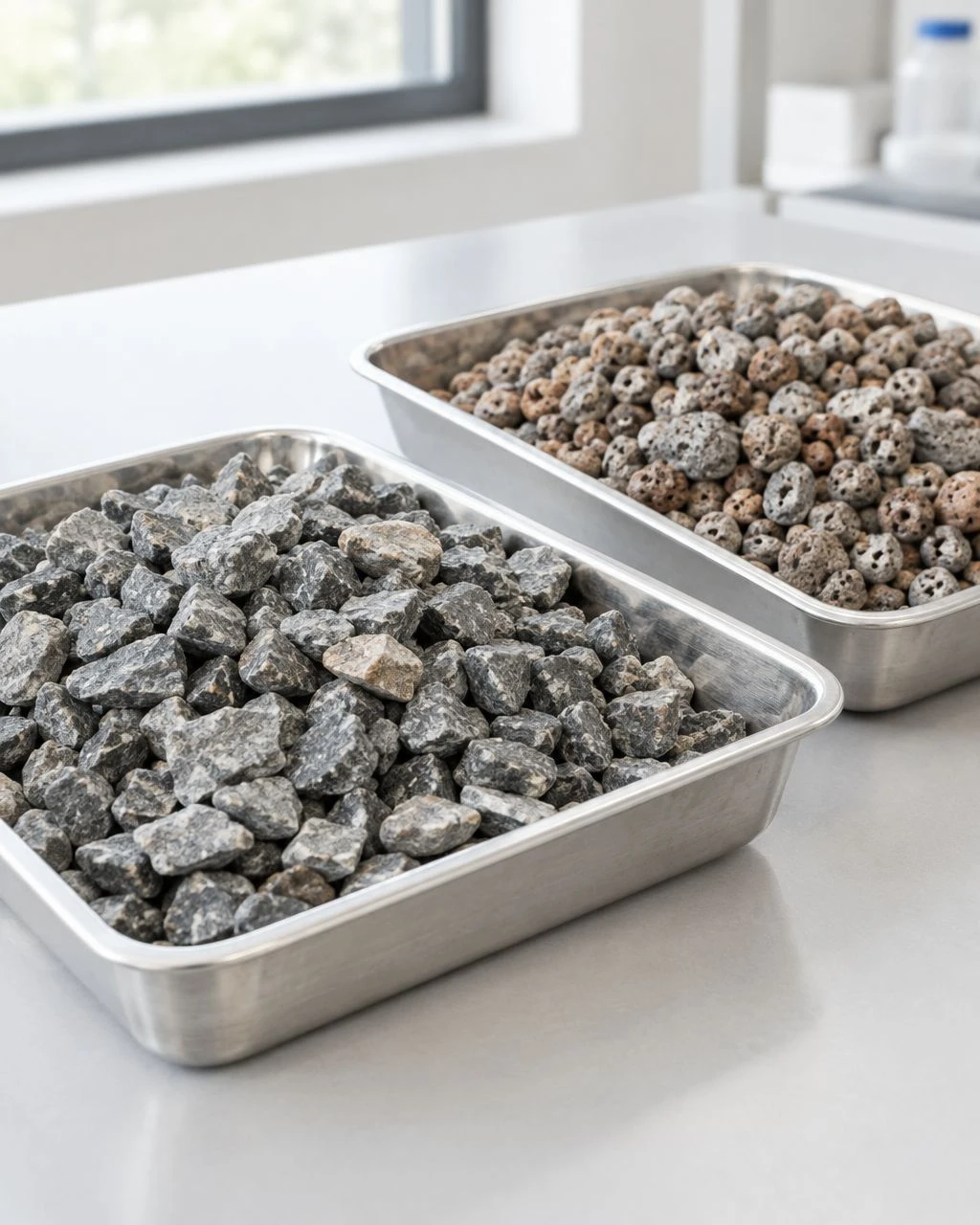
| Clean sand, sand and gravel mixtures | 10−3 to 1 | Good |
| Fine sand, silty sand | 10−5 to 10−3 | Fair to poor |
| Silt, clayey silt | 10−7 to 10−5 | Poor |
| Clay | Less than 10−7 | Practically impervious |
Gradation, density, structure and fissures can move a soil well outside its typical range.
How do you choose a permeability test?
- Classify the soil. Use gradation and fines content to place it on the chart.
- Pick the method. Constant head (ASTM D2434) for granular soils; falling head for silts and less permeable soils; flexible-wall (ASTM D5084) for very low-k clays.
- Prepare the specimen at the density and moisture the project requires.
- Saturate fully, because trapped air lowers measured k.
- Run the test, calculate k and correct to 20 °C.
Constant head test: sands and gravels
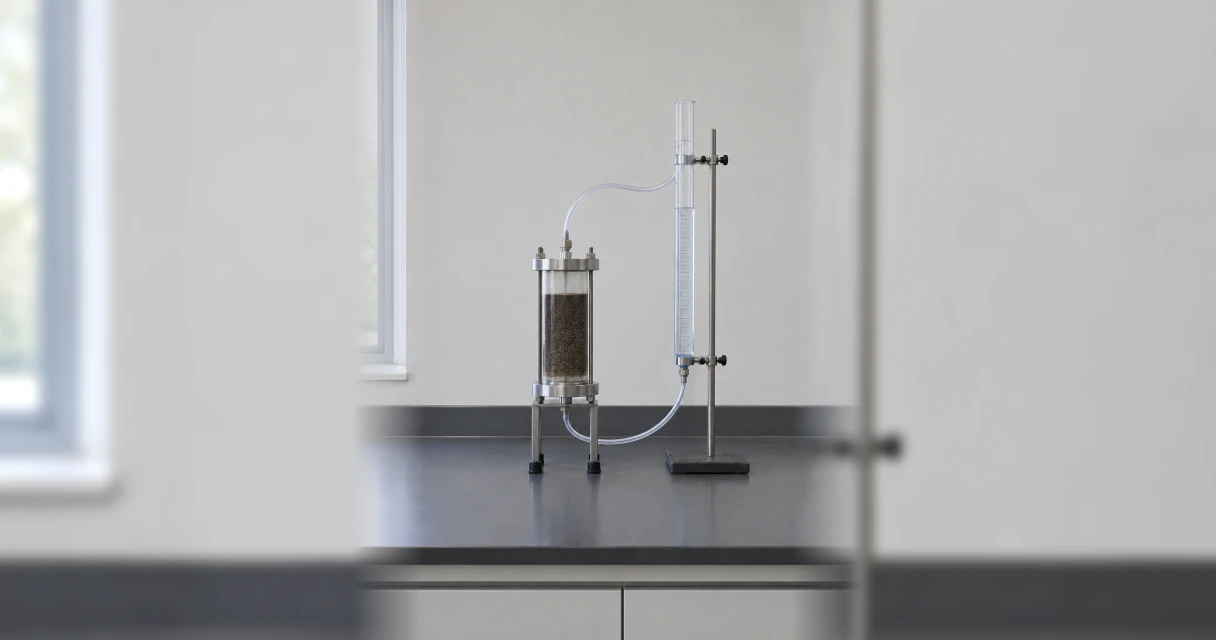
Water flows through the specimen under a constant head, and the volume collected over a set time gives k:
k = Q × L ÷ (A × h × t), where Q is volume collected, L specimen length, A area, h head difference and t time.
Best for: sands and gravels with flow fast enough to collect. A constant head tank keeps the head steady. The limitation: flow through fine-grained soils is too slow to measure this way.
Falling head test: silts and less permeable soils
The head in a standpipe falls from h1 to h2 over time t:
k = (a × L ÷ (A × t)) × ln(h1 ÷ h2), where a is the standpipe area.
Best for: silts and soils where flow is too slow to collect easily. The limitation: very low-k clays need a flexible-wall permeameter under ASTM D5084, which controls back pressure and confining stress.
Permeability equipment compared
| Equipment | Best for | Practical advantage | Limitation to manage |
|---|---|---|---|
| 4.5in constant and falling head set | Lab testing of granular and fine soils | Runs both methods | Specimen size limits maximum particle size |
| 6in constant and falling head set | Coarser soils | Larger specimen | More material to prepare |
| ASTM/AASHTO 6.0in permeameter | Standard granular testing | Standard cell size | Requires a head source |
| 4in compaction permeameter | Specimens compacted in the mold | Tests at compacted density | Smaller specimen |
| Double ring permeameter | Field infiltration | Tests in place | Measures infiltration, not lab k |
Why permeability results vary
- Fines content: k is controlled largely by the finest fraction.
- Density and void ratio: compaction reduces voids and k.
- Soil structure: flocculated clays and fissured soils are more permeable than dispersed ones.
- Saturation: trapped air lowers measured k.
- Water temperature: results are normally corrected to 20 °C.
How is Darcy’s law used?
Flow through soil follows q = k × i × A, where q is flow rate, i the hydraulic gradient (head loss divided by flow length) and A the cross-sectional area. Permeability tests apply a known gradient and measure flow to solve for k.
Where are permeability results used?
- Drainage design: choosing filter and drain materials.
- Seepage analysis: dams, levees and excavations.
- Liners and caps: compacted clay liners often must reach 1 × 10⁻⁷ cm/s or lower.
- Consolidation: low-k clays settle slowly under load.
FAQ
Which soil has the highest permeability?
Clean, coarse gravel. Clay has the lowest.
How do I convert cm/s to ft/day?
Multiply by about 2,835. For example, 10−3 cm/s is about 2.8 ft/day.
When should I use a falling head test instead of a constant head test?
Use a falling head test for silts and less permeable soils where flow is too slow to collect. Use constant head for sands and gravels.
How are clay liners tested for permeability?
Labs use a flexible-wall permeameter under ASTM D5084. Liners often must reach 1 × 10⁻⁷ cm/s or lower.
Why must permeability be corrected to 20 °C?
Water viscosity changes with temperature, which changes flow rate. Correcting to 20 °C makes results comparable.
Wrapping Up
The chart narrows the range; the test sets the value. Match the method to the soil, saturate fully and correct for temperature before using k in design.
Certified Material Testing Products supplies constant and falling head test sets, permeameters and field infiltration equipment. Browse our permeability test equipment.
Topics: Soil Testing; Soil Permeability; Hydraulic Conductivity.