Sieve Mesh Sizes: The Guide to Understanding Different Mesh
Posted by Matt Johnson on Jun 11, 2024
Specify test sieves by their nominal opening in millimeters or micrometers and their US standard sieve number under ASTM E11, not by mesh count alone. Traditionally, mesh number is the number of openings per linear inch of wire cloth, so a higher number means smaller openings. Because the actual opening also depends on wire diameter, the opening size is what matters for test results.
- A US No. 200 sieve has a 75 µm (0.075 mm) opening; No. 4 is 4.75 mm.
- ASTM E11 frames are usually 8in or 12in; ISO 3310-1 frames are 200 mm or 300 mm and do not always nest with US sieves.
- Start with the sieves your test method lists, then add intermediate sieves to prevent overloading.
Why this matters
Two cloths with the same mesh count but different wire thickness have different openings. Ordering by mesh count alone, mixing US and ISO frames, or using stretched mesh all change gradation results.
Order sieves by standard and opening, then keep them verified. Compare our ASTM test sieves and ISO test sieves.
How do mesh number, sieve number and opening differ?
- Mesh count: openings per inch. Two cloths with the same count but different wire thickness have different openings.
- US standard sieve number (ASTM E11): a designation tied to a defined nominal opening and wire diameter. It is close to, but not always identical to, the mesh count.
- Nominal opening: the size of the square hole, in mm or µm. This is the value that matters for test results.
Sieve size conversion chart
| US sieve No. | Opening (mm) | Opening (µm) | Opening (in) |
|---|---|---|---|
| No. 4 | 4.75 | 4,750 | 0.187 |
| No. 8 | 2.36 | 2,360 | 0.0937 |
| No. 10 | 2.00 | 2,000 | 0.0787 |
| No. 16 | 1.18 | 1,180 | 0.0469 |
| No. 20 | 0.850 | 850 | 0.0331 |
| No. 30 | 0.600 | 600 | 0.0234 |
| No. 40 | 0.425 | 425 | 0.0165 |
| No. 50 | 0.300 | 300 | 0.0117 |
| No. 60 | 0.250 | 250 | 0.0098 |
| No. 80 | 0.180 | 180 | 0.0070 |
| No. 100 | 0.150 | 150 | 0.0059 |
| No. 140 | 0.106 | 106 | 0.0041 |
| No. 200 | 0.075 | 75 | 0.0029 |
| No. 325 | 0.045 | 45 | 0.0017 |
| No. 400 | 0.038 | 38 | 0.0015 |
For coarse sieves above No. 4 (designated by opening, such as 3/8in or 1in), see our US sieve size chart.
How do you choose the right sieve sizes?
- Start with the test method. ASTM C136, C33 and D6913 list the sieves required.
- Add intermediate sieves where needed to prevent overloading.
- Choose the diameter. 8in for most fine work, 12in for larger coarse samples, 3in for small samples.
- Choose the materials. Brass or stainless frames and mesh; stainless for wet sieving.
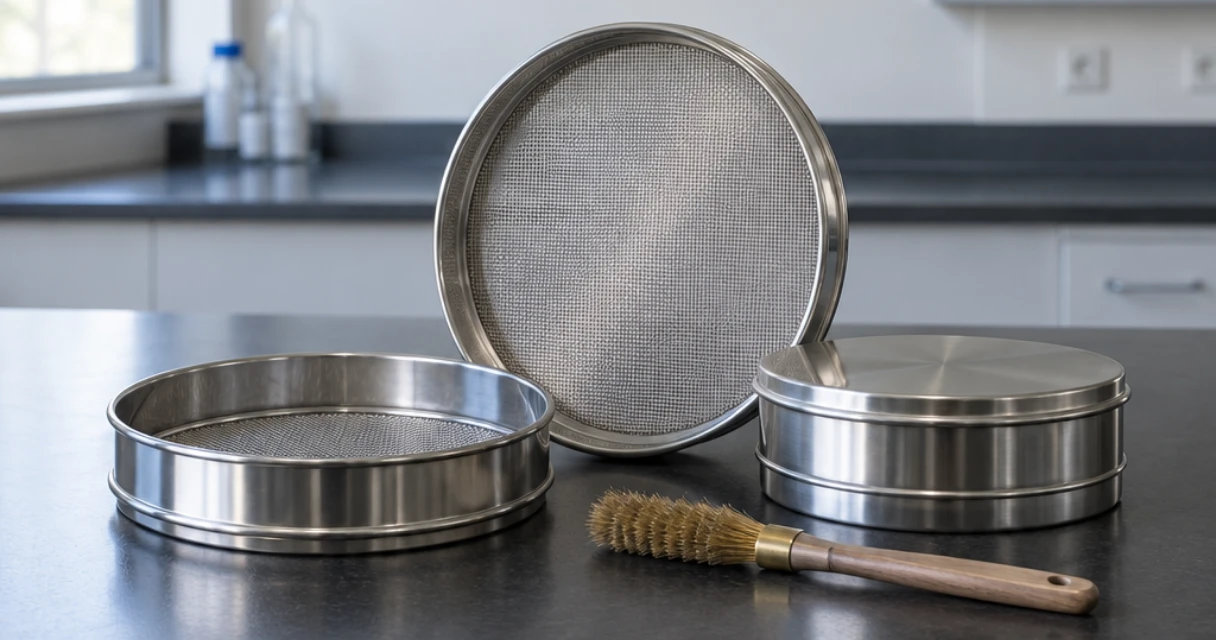
- Include a pan and cover for every stack.
- Specify inspection or calibration grade when your accreditation calls for documented opening statistics.
8in ASTM sieves: the standard for fine work
8in sieves cover most soil and fine aggregate testing. A common example is the Gilson 8in all-brass full-height No. 200 sieve, used for washing fines.
Best for: fine fractions and standard shaker stacks. The limitation: coarse samples overload them quickly.
12in ASTM sieves: larger coarse samples
12in sieves give more sieving area for coarse aggregate.
Best for: coarse fractions and larger specimens. The limitation: they need a compatible shaker.
Electroformed sieves: openings finer than about 20 µm
Electroformed sieves replace woven wire cloth where openings are finer than about 20 µm.
Best for: very fine powders. The limitation: they are delicate and need careful cleaning.
Test sieve options compared
| Option | Best for | Practical advantage | Limitation to manage |
|---|---|---|---|
| 8in ASTM E11 | Most fine soil and aggregate work | Standard size, fits most shakers | Overloads with coarse material |
| 12in ASTM E11 | Coarse aggregate | More sieving area | Needs a compatible shaker |
| ISO 3310-1 (200 / 300 mm) | Labs working to ISO methods | Harmonized openings | Frames may not nest with US sieves |
| Full-height frame | Larger samples | Holds more material | Fewer sieves per stack |
| Half-height frame | Long stacks in one shaker | More sieves per stack | Less capacity per sieve |
| Electroformed | Openings below about 20 µm | Precise fine openings | Delicate |
Why sieve results vary
- Wire diameter: the same mesh count can produce different openings.
- Standard mixing: US and ISO frames do not always nest together.
- Mesh damage: dents, stretched openings and loose seals pass oversize particles.
- Overloading: too much material blinds the mesh.
- Cleaning: poking particles through with a sharp tool distorts openings.
How do you care for and verify test sieves?
- Brush from the underside with a soft sieve brush; never poke particles through.
- Use an ultrasonic sieve cleaner for fine mesh.
- Inspect before each use for dents, stretched openings and loose seals.
- Verify periodically by optical inspection or with a sieve inspection kit.
FAQ
What is 200 mesh in microns?
A US No. 200 sieve has a 75 µm (0.075 mm) opening.
Is a higher mesh number finer?
Yes. A higher number means more openings per inch and smaller openings.
Is mesh count the same as US sieve number?
Not always. The ASTM E11 sieve number is tied to a defined opening and wire diameter; it is close to, but not always identical to, the mesh count.
Can I stack ASTM and ISO sieves together?
Not reliably. US sieves are usually 8in or 12in and ISO sieves 200 mm or 300 mm, so frames do not always nest. Pick one system for your lab.
When do I need electroformed sieves?
For openings finer than about 20 µm, where woven wire cloth is not practical.
Wrapping Up
Order by opening and standard, then keep the mesh sound. The right sizes, one frame system and regular verification protect every gradation result.
Certified Material Testing Products supplies ASTM and ISO test sieves, electroformed sieves, brushes and inspection kits. Browse our ASTM test sieves.
Topics: Test Sieves; Sieve Analysis; Mesh Size.