ASTM D6938: Soil and Soil-Aggregate Density Tests by Nuclear Methods
Posted by Matt Johnson on Aug 05, 2024
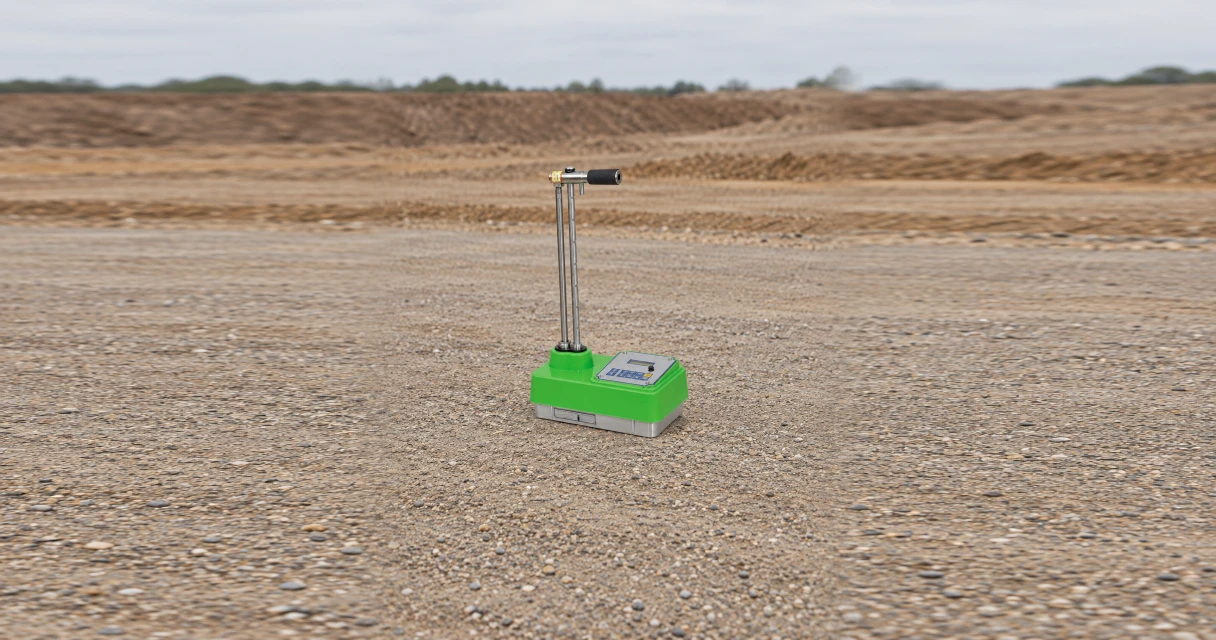
ASTM D6938 is the standard test method for in-place density and water content of soil and soil-aggregate using a nuclear gauge at shallow depths. It lets a technician check compaction on an embankment, subgrade or base course in a few minutes, without digging a hole and weighing the material. It replaced the older ASTM D2922 (density) and D3017 (moisture) methods.
- Direct transmission (2in to 12in deep) is the more accurate mode for most soil and base testing; backscatter suits thin layers.
- Check gauge moisture against oven-dry water content (ASTM D2216) and correct where needed.
- Owning, using and transporting a nuclear gauge requires a radioactive materials license, trained operators and Type A packaging.
Why this matters
Compaction acceptance often rides on a single gauge reading. A skipped standard count, a poorly prepared test site or an uncorrected moisture reading can pass soft fill or reject good work.
The gauge is fast, but only reliable when the daily checks and corrections are done. Compare gauges, cases and parts in our nuclear density gauges category.
How does a nuclear density gauge work?
- Gamma source (typically cesium-137): gamma rays pass through the soil to detectors in the gauge base. Denser soil absorbs more radiation, so fewer counts reach the detector.
- Neutron source (typically americium-241/beryllium): fast neutrons are slowed by hydrogen, mostly in water, so the count of slowed neutrons indicates moisture content.
The gauge converts counts to wet density and water content using its factory calibration, then calculates dry density.
How do you run a D6938 test?
- Take a standard count each day on the reference block, in the same position and away from other gauges and large objects. A reading outside the allowed range means the gauge needs checking.
- Prepare the site. Remove loose material and level the surface. Fill small voids with fine sand so the base sits flat.
- Form the access hole with the drill rod and scraper plate, at least 2in (50 mm) deeper than the test depth.
- Lower the source rod to the test depth, seat the gauge and pull it gently so the rod contacts the side of the hole nearest the detectors.
- Take the reading for the count time your specification sets (commonly one minute).
- Return the source to the safe position before moving the gauge.
Direct transmission: the standard mode for soil and base
The source rod is lowered into a pre-formed hole, typically 2in to 12in (50 to 300 mm) deep, in 2in steps.
Best for: most soil and aggregate base testing. It is more accurate and less affected by surface texture. The limitation is the access hole, which must be formed cleanly and slightly deeper than the test depth.
Backscatter: surface readings for thin layers
The source and detectors stay at the surface.
Best for: thin layers or surfaces where a hole cannot be made. The limitation is depth bias: readings are weighted toward the top inch or two.
Field density methods compared
| Method | Best for | Practical advantage | Limitation to manage |
|---|---|---|---|
| Nuclear gauge, direct transmission (D6938) | Most soil and aggregate base testing | Results in minutes | License, training, dosimetry and transport rules |
| Nuclear gauge, backscatter (D6938) | Thin layers where no hole can be made | No access hole | Biased toward the surface |
| Sand cone (D1556) | Verifying gauge results; sites without a licensed gauge | No license needed | Slower; requires excavation and weighing |
| Drive cylinder (D2937) | Cohesive soils without gravel | Simple equipment | Not suitable for gravelly soils |
For non-nuclear options, see our sand cone test guide, the density drive sampler and all field density test equipment.
Why nuclear gauge results vary
- Standard count drift: a gauge outside its daily range is not reliable.
- Surface preparation: air gaps under the base lower the density reading.
- Rod contact: the rod must touch the hole wall nearest the detectors.
- Material chemistry: hydrogen-bearing minerals, organics, boron or chlorine give false moisture readings.
- Nearby objects: other gauges, vehicles and walls can affect counts.
How do you correct moisture and calculate compaction?
Check gauge moisture against oven-dry water content (ASTM D2216) on samples from the same material and apply a correction where needed. A lab oven and soil moisture testing equipment cover this step.
Percent compaction = field dry density ÷ maximum dry density × 100. Maximum dry density comes from a laboratory Proctor test (ASTM D698 or D1557) on the same soil. Specifications commonly require 95% of standard Proctor; use your contract value. An automatic soil compactor speeds Proctor work in a busy lab.
What licensing and safety rules apply?
In the United States you need a radioactive materials license from the NRC or your Agreement State, a designated radiation safety officer, operator training and dosimetry. Transport requires a Type A package, shipping papers and DOT hazmat training. Store the gauge locked and secured, and keep bystanders back during testing. See our Type A shipping cases.
FAQ
How deep can a nuclear gauge test?
In direct transmission mode, most gauges test from 2in to 12in (50 to 300 mm) in 2in steps.
Do I need a license to rent a nuclear density gauge?
Yes. The user must be covered by a radioactive materials license, whether the gauge is owned or rented.
Can ASTM D6938 be used on asphalt?
No. Asphalt density with a nuclear gauge is covered by ASTM D2950. D6938 is for soil and soil-aggregate.
What standards did D6938 replace?
ASTM D6938 replaced ASTM D2922 for nuclear density and D3017 for nuclear moisture.
Why does the gauge need a daily standard count?
The standard count on the reference block confirms the gauge is operating within its expected range. A count outside the allowed range means the gauge needs checking before testing.
Wrapping Up
Fast readings still need daily checks and moisture correction. Take the standard count, prepare the site, seat the rod properly and verify moisture against oven-dry samples.
Certified Material Testing Products supplies nuclear density gauges, Type A shipping cases, Proctor equipment and non-nuclear alternatives. Start with our nuclear density gauges.
Topics: Soil Compaction; Nuclear Density; Field Density.