How to Choose a Concrete Hopper
A concrete hopper is a steel funnel that catches concrete from a chute, pump hose, crane bucket or ready-mix truck and releases it where you need it, at a controlled rate. The right hopper depends on two things: how the concrete arrives and where it has to go. The sections below match each type of hopper to the job it does best.
Tremie Hoppers and Collection Hoppers for Walls, Columns and Deep Forms
When concrete falls freely into a tall form, the stone separates from the paste and the wall ends up with honeycombing and weak spots. A tremie hopper solves this by funneling the pour into a drop pipe or elephant trunk that carries it to the bottom of the form. For residential footings and small columns, a mini tremie hopper or the mini tremie hopper with a 6ft trunk is light enough for one person to place and move. Steel tremie hoppers with an 8in opening or a 12in opening stand up to daily commercial use.
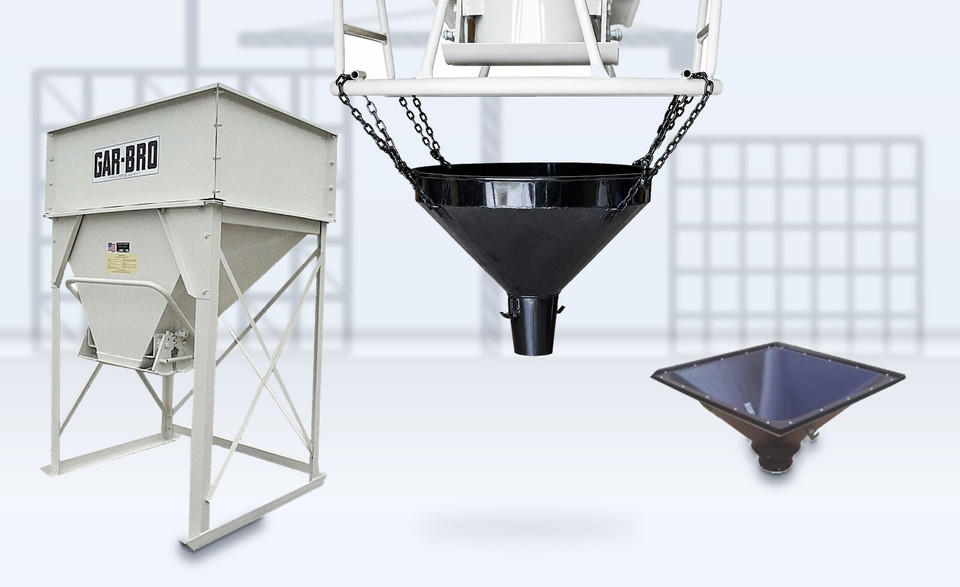
Gar-Bro center discharge collection hoppers cover larger pours, with top openings from 14 x 26in up to 42 x 42in and discharge outlets of 6, 8, 12 or 16in to match your tremie pipe or elephant trunk. The 30 x 30in collection hopper with an 8in outlet is the most common size. For long, narrow wall forms, vertical front discharge collection hoppers have a rectangular outlet that feeds rectangular trunks.
Hoppers That Hang From a Crane Bucket
On high-rise and bridge work, the hopper often travels with the concrete bucket. A flexible accordion hopper attaches below the bucket gate and stretches down into narrow forms, so concrete is placed low instead of dropped from height. Extended discharge accordion hoppers reach 6 to 12ft with an 8 or 12in trunk. The suspended steel sub-hopper hangs underneath the bucket and connects to elephant trunk with a steel collar for deep, confined pours. Remove the sub-hopper before you set the bucket on the ground.
Floor Hoppers for Filling Carts and Buggies
When the truck cannot reach the pour, a floor hopper gives the driver a fast place to unload and lets your crew fill carts at their own pace. Gar-Bro floor hoppers come in two layouts. Center discharge models have the gate underneath and hold 1.2 to 5.4 cu yd. Vertical front discharge models put the gate on the front face, which makes it easier to roll a concrete cart or buggy straight up to it, and hold 1 to 5 cu yd. The standard stand gives 36in of clearance under the gate. Tall stands raise the loading height to between 96 and 120in for taller equipment. Double gate versions let two crew members fill at the same time.
Rock Hoppers for Aggregate and Heavy Material
Heavy-duty rock hoppers are built for stone, gravel and other abrasive bulk material rather than wet concrete. Sizes run from 1.4 to 10 cu yd, and the 10 cu yd model is also offered with an air-operated gate.
Matching the Hopper to Your Pour
Match the hopper outlet to the diameter of the pipe or trunk it feeds, and size the top opening to the chute or bucket that fills it. A wider top catches more of the stream from a ready-mix chute, while a narrow, deep form needs a small outlet and a long trunk. If you are unsure which concrete hopper fits your setup, call our team with the form depth and the way the concrete will arrive. You can also see the rest of our concrete pouring equipment, including concrete buckets and chutes.