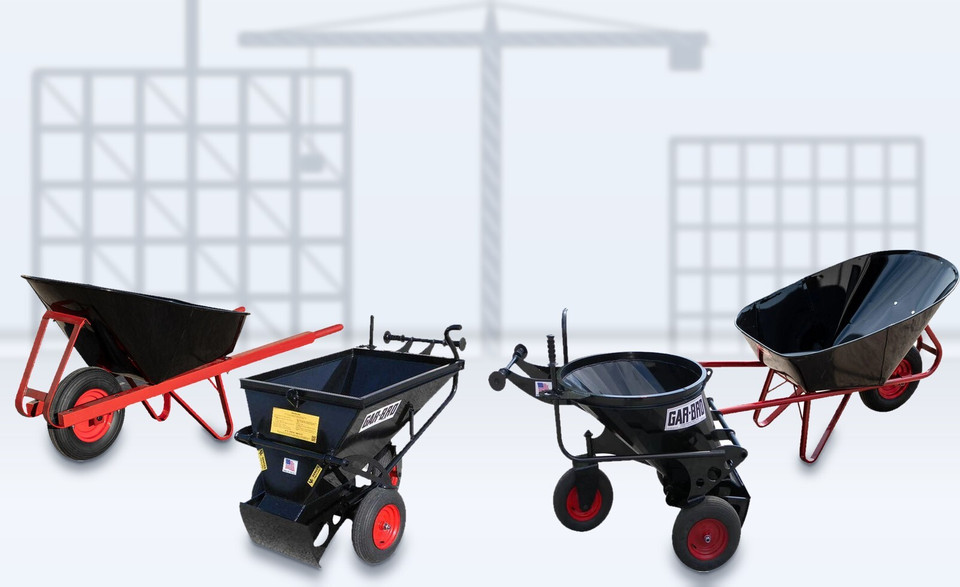
Moving Concrete by Hand: Carts, Buggies and Wheelbarrows
When the ready-mix truck or pump cannot reach the pour, the concrete has to travel the last stretch by hand. A manual concrete buggy, a two-wheeled concrete cart or a contractor wheelbarrow carries the load from the truck or floor hopper to the form. Which one is best depends on how much concrete you move per trip, how far you push it and how much room you have to work.
Two-Wheeled Concrete Carts
A concrete cart carries more than a wheelbarrow and balances its load over two wheels, so it is steadier on planks and uneven ground and less tiring to push. Gar-Bro carts run on 4.00 x 18 tires. The 4 cu ft concrete cart is only 27in wide, narrow enough to fit through most doorways and walkways, with a 32in loading height. Step up to the 6 cu ft or 8 cu ft concrete cart on open sites where fewer trips matter more than a tight turn.
The rocker dump concrete cart has the same 8 cu ft body, but it rocks forward to dump, so one person can empty a full load into a form without lifting the handles.
Three-Wheeled Concrete Buggies for Slip Forms
Gar-Bro three-wheeled concrete buggies are pushed by hand, with no engine to fuel or maintain. Instead of dumping the whole load at once, they meter concrete out through a self-closing 8 x 10in gate, which is why they are a favorite for slip form work such as curbs and barrier walls. A manual hand brake holds the buggy in place while you fill the form. Choose the rectangular top buggy (6.4 cu ft) or the round top buggy (6 cu ft). Both have a 36in loading height.
Contractor Wheelbarrows for Concrete
The best wheelbarrow for concrete has a deep steel tray, a solid frame and a pneumatic tire that rolls easily under a heavy load. Gar-Bro contractor wheelbarrows come in 4 and 4.5 cu ft sizes, with a choice of wood handles or steel handles. A 4 cu ft wheelbarrow holds roughly 0.15 cu yd, so plan on about seven trips for every cubic yard you place.
Cart, Buggy or Wheelbarrow?
For small pours, patching and tight spaces, a wheelbarrow is the simplest tool. For longer pushes and larger volumes, a two-wheeled concrete cart moves up to twice as much per trip with less effort. For curb, gutter and slip form work, where concrete has to flow into the form at a steady rate, a three-wheeled concrete buggy with a metering gate is the right choice. Keep crews moving with spare parts such as a replacement wheel and tire.
To fill carts and buggies quickly, have the truck unload into a floor hopper. You can also browse all concrete pouring equipment.