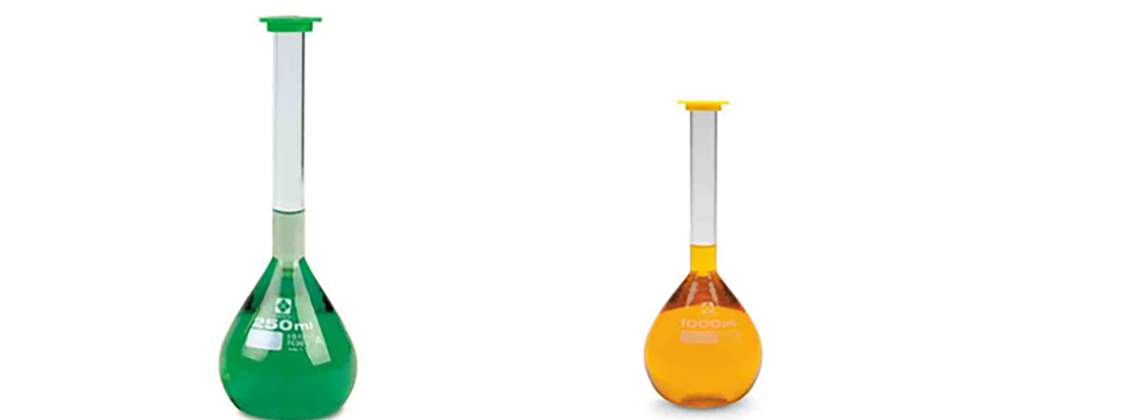
What is a Volumetric Flask Sizes, Shapes, and Uses
Posted by Certified Material Testing Products on May 02, 2023
A volumetric flask is an essential tool for any laboratory or scientific setting. Whether you're a budding chemist, seasoned scientist, or professional pharmacist, understanding the intricacies of volumetric flasks is essential for precise measurements and accurate experiments.
But let's not get ahead of ourselves. What is a volumetric flask? How is it designed? How does a volumetric flask function, and why is it so important when measuring a specific volume of liquid? After our helpful guide, you'll leave equipped with the knowledge you need to master the art of volumetric measurements and take your scientific experiments to the next level.
What is a volumetric flask?
The volumetric flask is a specialized laboratory flask used for accurate liquid volume measurements. All volumetric flasks measure volumes with extreme precision. The flasks are accurately calibrated to allow for precise volume measurements, making them perfect for analytical chemistry and scientific experiments that require a high degree of accuracy.
How is a volumetric flask designed?
A volumetric flask is typically pear-shaped with a narrow neck and flat bottom. Most volumetric flasks come with only a single volume mark. However, some customized flasks made for specialized tasks in an industrial setting may have multiple marks so that they can be used for several unique purposes.
The design of the flask makes it the perfect utensil for finding precise measurements - the narrow neck allows for minimum evaporation and spillage during the transfer of liquid, and the mark on the neck is precisely calibrated so that the volume of liquid measured is exact once the bottom of the meniscus reaches the calibration line. The line is incredibly fine (etched with a diamond tool), reducing the chance of human error.
Many flasks also come with a volumetric flask stopper, which helps to contain solutions during transportation.
What are the differences between volumetric flasks and Erlenmeyer flasks?
Volumetric and Erlenmeyer flasks are both valuable types of scientific glassware that deserve a place on your laboratory bench. Although each type shares some similarities, the two have essential differences.
The Erlenmeyer (conical) flask has a conical shape with a flat bottom and narrow neck that widens toward the top. They are known for their versatility and durability. The Erlenmeyer flask is less precise than the volumetric flask, making it more suited to laboratory applications where absolute precision is not essential.
As the glass of an Erlenmeyer flask is thicker than that of a volumetric flask, the Erlenmeyer flask is typically used for experiments that involve heating.
Volumetric flasks provide a more accurate measurement than Erlenmeyer flasks and beakers. This makes them well-suited for precisely measuring volume or preparing solutions that require a specific concentration.
However, volumetric flasks aren't suited to rapid temperature increase, making Erlenmeyer flasks the glassware of choice when carrying out exothermic reactions.
What are volumetric flasks made of?
Volumetric flasks are typically made from high-quality borosilicate glass, a durable material that is resistant to chemical corrosion and thermal shock. However, plastic versions are available, which are typically appropriate for educational settings where highly accurate measurements aren't as important.
A glass volumetric flask is usually clear in color to allow for easy reading of measurements. However, some specialized flasks may be amber-colored to enable the handling of light-sensitive compounds like vitamin A or silver nitrate.
What is a volumetric flask used for?
Volumetric flasks are used in a wide range of laboratory applications. The flask's accuracy when measuring reagents means it is the industry standard for many scientific professions.
The flask’s unique qualities make it the ideal glassware for the following purposes:
- Measuring volumes accurately: A volumetric flask's primary function is to measure chemical solutions precisely and reliably because the flask is calibrated to a precise degree of accuracy.
- The preparation of standard solutions: The volumetric flask is commonly used to prepare standard solutions (a liquid containing a known concentration of a substance or element).
- The dilution of solutions: As volumetric flasks provide such an accurate measurement, they are ideal for diluting solutions to a precise concentration.
- Standardization: Volumetric flasks are an excellent way for scientists to standardize their laboratory procedures to ensure consistent results.
- Titration: The volumetric flask is commonly used in titration experiments, where a precise chemical reaction determines a solution's concentration.
- Mixing reagents: Many professionals use a volumetric flask to mix reagents with precise volumes of other liquids.
- Buffer preparation: In biological and biochemical experiments, volumetric flasks are typically used to prepare buffer solutions that require a highly-specific pH.
- Calibration: The standardized accuracy of volumetric flasks makes them ideal for calibrating other scientific instruments, such as laboratory glassware, burettes, and pipettes.
Class A vs. Class B: what's the difference?
There are two broad classes of volumetric flasks - class A and class B.
The two classes refer to the standards used in the manufacturing process of the flasks, and dictate the degree of precision that the flask must adhere to.
Class A volumetric flasks are the most accurate volumetric flasks and are manufactured with stricter tolerance levels than class B flasks. All class A flasks need to be accurate within ±0.05ml for flasks up to 200ml and ±0.10ml for flasks between 200ml and 2000ml. This means that a volumetric flask that holds 100ml must fall between the range of 99.95ml-100.05ml.
Class B volumetric flasks do not require as high a standard of accuracy during manufacturing as Class A flasks. All Class B flasks must be accurate within ±0.10ml for flasks up to 200ml and ±0.20ml for flasks between 200ml and 2000ml. With this in mind, a class B volumetric flask designed to hold precisely 100ml should fall between the range of 99.90ml-100.10ml.
Volumetric flask size guide
Volumetric flasks are manufactured in a range of sizes, each serving a distinct purpose for scientific studies, laboratory experiments, and the preparation of solutions.
The most common volumetric flask sizes are 100ml, 250ml, 500ml, and 1000ml. These sizes are suitable for a broad range of scientific applications.
Some flasks are much larger, such as the 2000ml and 5000ml volumetric flasks. These are typically used for large-scale operations, such as in pharmaceutical labs for preparing large production batches.
Others, such as 2ml, 5ml, 10ml, 20ml, 25ml, 40ml, and 50ml volumetric flasks, are suited to highly precise preparations, such as in the manufacturing of costly pharmaceutical drugs.
How do I use a volumetric flask step by step?
Now that we've explored the volumetric flask's different designs, types, and functions, it's time to detail how to use it for the best results.
Follow these steps to measure volumes and prepare accurate solutions precisely:
- Thoroughly clean the volumetric flask using water and soap to remove any remaining liquid from previous preparations.
- Rinse the flask with distilled water to remove impurities and prevent contaminations that could affect your measurements.
- Use a pipette, burette, or medicine dropper to slowly add the liquid to the flask until the bottom of the concave liquid curve (meniscus) touches the line marked on the flask when viewed at eye level.
- Gently swirl the flask to thoroughly mix the liquid materials once the desired volume is reached. For best results, use a magnetic lab stirrer.
- Now that you've mixed the solution in your volumetric flask, add more liquid to bring the meniscus to the level of the calibration mark if required.
- Remove excess liquid if needed. Use filter paper or a clean, dry cloth. Be careful not to touch the calibration line.
- Once you have exact measurements, decant or dispose of the solution and thoroughly clean the flask with distilled water to prepare it for the next use.
Extra tips for perfect measurements
Here are some helpful additional tips to ensure you always get the best out of your volumetric flask
- Make sure you calibrate your pipette, burette, or medicine dropper to the volumetric flask so you always know you're adding the correct amount of liquid.
- Always check the solution's temperature to ensure it doesn't exceed the tolerance of your glassware.
- Always use distilled water to clean the flask, as this reduces the chances of contamination affecting your measurements.
- Swirl the flask gently to avoid creating bubbles that could make the exact measurement harder to determine.
- Use a high-quality lab brush to ensure the flask is fully cleaned after each use.
Where can I find high-quality volumetric flasks?
Certified MTP offers a range of high-quality volumetric flasks, Erlenmeyer flasks, pipettes, burettes, lab stirrers, and brushes, custom-made to ensure you always get the best out of your scientific experiments.
We also offer an extensive selection of water baths, laboratory shakers, and incubators. All of our products are designed for everyday use and tested for durability. Whether you’re a working professional or a classroom teacher, our range of products are built for accuracy, reliability, and precision.
Looking for your next supplier of top-class lab equipment? Browse our full range here. Want to get in touch? Contact us today and ask away.