


Fast
Shipping

Quick,
Simple Ordering

Clear,
Upfront Pricing

Over 30,000
Happy Customers

Exceptional
Customer Service

Industry's Largest
Catalog
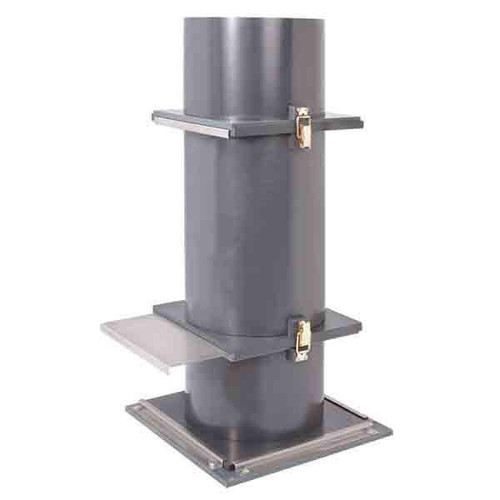
Static Segregation Column Mold for SCC Concrete
The Static Segregation Column Mold for Self-Consolidating Concrete (SCC) is a specialized testing tool used to evaluate the potential for static segregation in fresh SCC mixes by measuring coarse aggregate distribution in the top and bottom sections of a cylindrical specimen. This assessment is essential for quality control in deep-section applications such as walls and columns, where aggregate segregation can compromise flowability and structural integrity.
During testing, concrete is placed into the column and allowed to rest. Once static segregation has occurred, aggregate content in the top and bottom sections is measured, while the middle portion is discarded. The three-section design and sliding separator blades allow technicians to isolate and analyze coarse aggregate with minimal disturbance.
Importance of Segregation Testing
Static segregation occurs when heavier coarse aggregates settle differently than the finer mortar matrix in highly flowable mixes. This can lead to voids, honeycombing, and reduced strength, especially when the concrete must flow around reinforcement or into confined formwork. The Static Segregation Column Mold helps identify these risks early, ensuring consistent mix performance and better long-term durability.
For additional evaluation of SCC behavior, related tools like the L Box Test Apparatus for Self-Consolidating Concrete help measure flow and passing ability of concrete in confined spaces, providing complementary data to segregation testing.
ASTM C1610 Static Segregation Testing
The mold is designed to meet ASTM C1610 requirements, offering a standardized method for identifying static segregation in SCC mixtures. Typical applications include:
- Structural elements with deep sections
- Walls and vertical members
- Columns and heavily reinforced zones
Static segregation testing evaluates whether coarse aggregates are too prone to separation, which can hinder concrete flowability and homogeneity in practical placements.
In addition to segregation tests, professionals may use the Self-Consolidating Concrete (SCC) Penetration Test Apparatus to quickly assess whether an SCC mixture is likely to exhibit segregation under field conditions. This complements column testing by providing a rapid indication of static segregation resistance.
How the Static Segregation Column Works
- Concrete is placed into the column
- The column rests undisturbed
- Separator blades isolate top, middle, and bottom sections
- Middle portion is discarded
- Coarse aggregate from top and bottom sections is recovered and weighed
The design allows one-person operation and minimizes sample loss during transfer. Sliding separator blades move cleanly between sections, enabling precise aggregate separation and accurate comparison of coarse content.
Challenges in SCC Segregation Testing
While SCC is prized for self-leveling and high flowability, these same characteristics can make it prone to static segregation. Key challenges include:
- Ensuring representative sampling
- Handling highly fluid mixtures
- Maintaining blade and equipment integrity
- Avoiding contamination during section separation
Because segregation testing involves manual handling and multiple steps, proper equipment — including corrosion-resistant molds — is critical to obtaining repeatable and trustworthy data.
Complementary SCC Testing Tools
To further enhance SCC evaluation, consider these related certified testing tools:
- L Box Test Apparatus — assesses concrete’s ability to pass around reinforcement. Certified MTP
- Self-Consolidating Concrete SCC Penetration Test Apparatus — rapid indication of static segregation resistance. Certified MTP
- J Ring Test Set: Apparatus for SCC — evaluates passing ability in congested reinforcement conditions. Certified MTP
- V-Funnel Flowability Test for SCC — measures flowability and segregation resistance. Certified MTP
Using a combination of these testing tools helps provide a comprehensive evaluation of SCC performance, from segregation tendencies to flow and passing ability.
Applications of the Static Segregation Column Mold
The Static Segregation Column Mold is essential in:
- Geotechnical and materials laboratories
- Quality control programs for precast and cast-in-place concrete
- Construction sites requiring high-performance SCC mixes
- Research environments focusing on concrete durability and structural reliability
By comparing aggregate masses in the top and bottom sections of a sample, engineers can quantify the degree of static segregation, leading to better mix adjustments and improved performance in critical structural sections.
Summary
The Static Segregation Column Mold for SCC Concrete is a vital tool for evaluating coarse aggregate segregation in self-consolidating concrete mixes. By complying with ASTM C1610 and providing clear partitioning of concrete sections, this mold enables accurate segregation analysis — helping engineers, QC technicians, and concrete technologists ensure flowability, consistency, and structural performance in demanding construction applications.