


Fast
Shipping

Quick,
Simple Ordering

Clear,
Upfront Pricing

Over 30,000
Happy Customers

Exceptional
Customer Service

Industry's Largest
Catalog
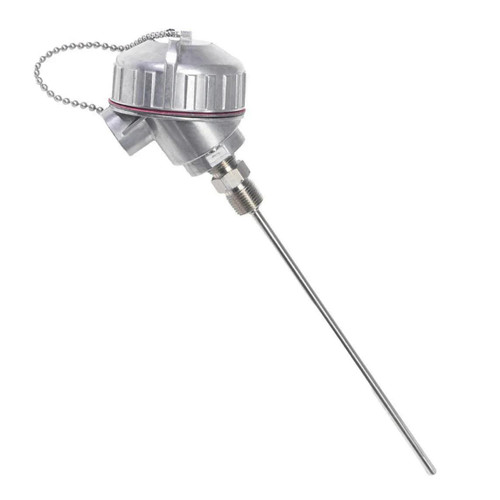
Spring-Loaded RTD Assembly with Screw-Cover Head, 4-inch Length
Product Overview
Resistance Temperature Detectors (RTDs) are sensors used to measure process temperatures with exceptional accuracy, repeatability, and interchangeability. This specific model is a spring-loaded assembly, which ensures consistent, positive contact between the sensor tip and the thermowell bottom for optimal heat transfer and faster, more reliable readings. It is housed in a durable screw-cover head, providing protection from dust, moisture, and environmental contaminants.
Principle of Operation
RTDs, also known as resistance thermometers, operate based on the principle that the electrical resistance of certain metals changes predictably with temperature. An RTD is built with a sensing element made of a pure metal, most commonly platinum (Pt), nickel (Ni), or copper (Cu). Platinum is the industry standard due to its wide temperature range, high accuracy, and excellent stability.
In practice, a small, constant excitation current is passed through the sensing element. As the process temperature changes, the element's resistance changes accordingly. The resulting voltage drop across the element is measured, calculated, and converted into a precise temperature reading. RTD elements are typically constructed in one of two ways:
- Wire-Wound Elements: A fine platinum wire is carefully coiled around a ceramic or glass core for stability.
- Thin-Film Elements: A thin layer of platinum is deposited onto a ceramic substrate, allowing for smaller, more vibration-resistant sensors.
Wiring Configurations for Enhanced Accuracy
Because RTDs have a low initial resistance (e.g., 100 ohms for a Pt100) and a relatively small change in resistance per degree, the resistance of the lead wires connecting the sensor to the control device can introduce significant measurement errors. To counteract this, RTDs are commonly available in 3-wire or 4-wire configurations, which allow the measuring instrument to compensate for and effectively cancel out the lead wire resistance, ensuring the reading reflects only the temperature at the sensor tip.
Built for Industrial Environments
By selecting the appropriate sensing element and protective sheathing materials (like 316 Stainless Steel), RTDs can be engineered to operate reliably across a broad temperature spectrum, from cryogenic lows of -200°C (-328°F) to high temperatures up to 600°C (1112°F).
Pyromation's RTD Solutions
Pyromation is a leader in manufacturing high-quality RTDs for a vast range of industrial applications. Our offerings include:
- Single- or dual-element RTDs for standard or redundant measurements.
- A variety of resistance values, including industry-standard Pt100 and high-sensitivity Pt1000 sensors.
- Specialized designs, such as Sanitary Clean-in-Place (CIP) configurations for food, beverage, and pharmaceutical industries.
If our extensive catalog doesn't contain the exact product for your needs, our expert engineers will collaborate with you to design a custom temperature sensor assembly. This can include specialized connection heads, protective thermowells, and integrated temperature transmitters to convert the RTD signal to a standard 4-20mA output.
Specifications
- Temperature Range: -200°C to 200°C
- Process Connection: 1/2" NPT in 316 Stainless Steel
- Conduit Opening: 3/4" NPT

