

Fast
Shipping

Quick,
Simple Ordering

Clear,
Upfront Pricing

Over 30,000
Happy Customers

Exceptional
Customer Service

Industry's Largest
Catalog
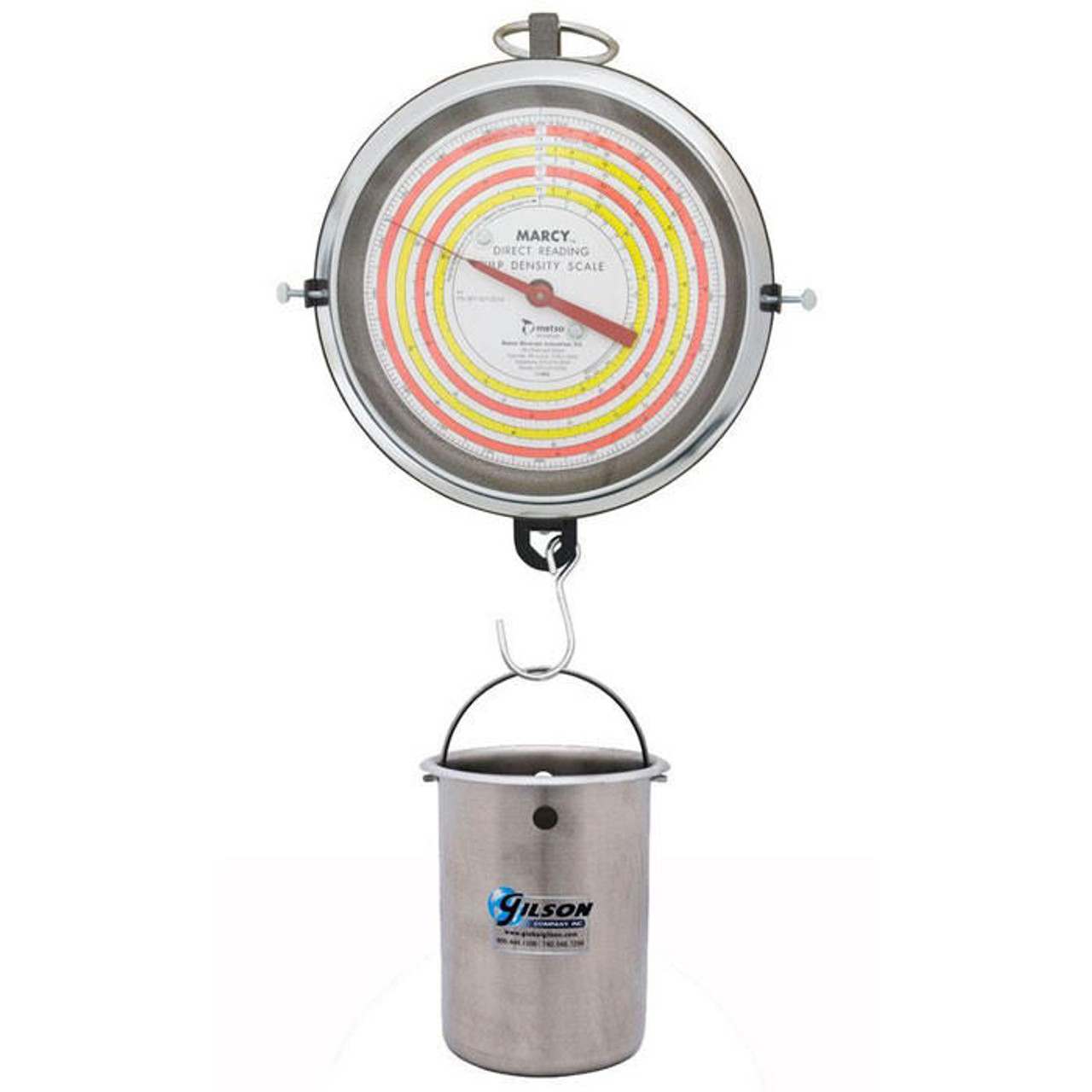
Pulp Density Scale: Specific Gravity Scale, Steel Container
Introduction to Density Measurement
Density measurement is important in many industries such as mining, pulp and paper, and chemical processing. The specific gravity scale is a key tool to measure density of liquids, pulps and dry solids. The Marcy Pulp Density Scale is a popular instrument that gives direct readings of pulp densities and specific gravities. With its interchangeable dial faces, the scale has a specific gravity range of dry solids from 1.2 to 7.8, making it a versatile tool for many applications. The scale gives accurate and fast measurements, eliminates errors and saves time, that’s why it’s an essential instrument in many industries.
A Guide to Pulp Density/Specific Gravity Scale
The Pulp Density/Specific Gravity Scale is a handy tool to measure pulp densities and specific gravities for all sorts of materials, pulps, liquids and dry solids. With this scale you can read specific gravity, percent solids and weight in kg without any calculations, reducing operator errors and giving consistent results.
This stainless steel density scale is used in laboratories all over the USA and beyond for industries like mining, construction and material processing.
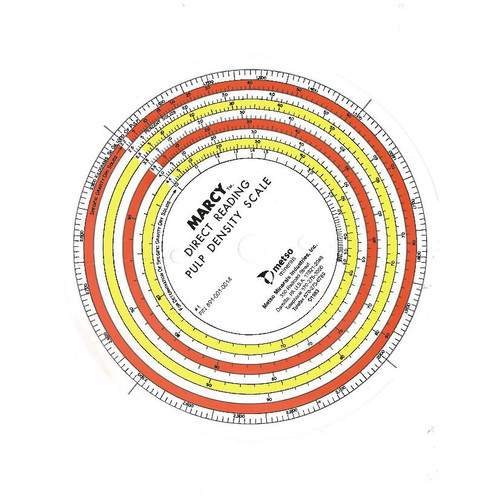
This stainless steel specific gravity scale has a range of measurement from 1.2 to 7.8 specific gravity of dry solids. It’s achieved by using twelve interchangeable dial faces that come with the product. These dial faces allow easy adjustments according to the material being measured making it versatile for many applications. The scale is furnished with interchangeable dial faces and specific containers.
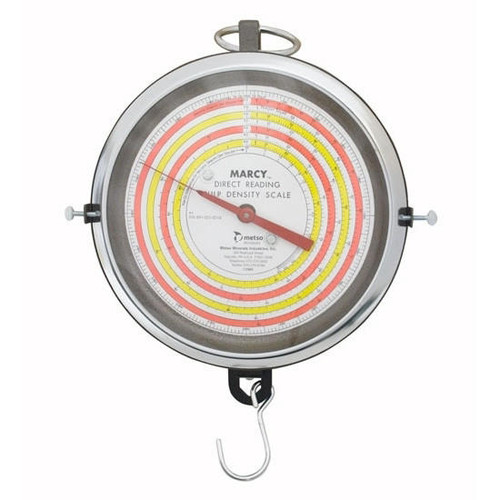
Made from painted carbon steel this density scale is built to last. It has a large 10in (254mm) circular dial with an acrylic lens for clear readings. The scale is compact (10in x 3in; 254 x 76.2mm) and can be used in laboratory or industrial settings.
Specs:
-
Capacity: 3,000g
-
Readability: 10.0g
-
Product Dimensions: 10in x 3in (254 x 76.2mm), Diameter x Height
-
Dial Diameter: 10in (254mm)
Accessories:
-
Dial Faces: A set of twelve interchangeable dial faces that give specific gravity readings for different materials like stainless steel.
-
1,000ml Clear Plastic Container: Has slotted overflow holes specifically designed for this scale.
-
1,000ml Stainless Steel Container: stainless steel container round overflow holes for heavy duty use.
For best use a 1,000ml stainless steel scale container is required and is available separately in clear plastic or carbon steel. The stainless steel scale containers are designed with slotted or round overflow holes for precise measurement and ease of use.
This Pulp Density/Specific Gravity Scale is used in the USA because of its accuracy and reliability in determining the density and specific gravity of materials for processes like mineral beneficiation, construction and chemical manufacturing. Whether you need to measure the thickness of a slurry in a mining operation or measure the specific gravity of materials in a laboratory, this scale gives you the accuracy and durability you need for consistent performance. It prevents errors in measurements by providing direct readings.
What is Density
Density is a fundamental physical property that describes the amount of mass contained in a given volume of a substance. It is an intensive property, meaning that it remains constant regardless of the object’s size. Density is typically measured in units of mass per unit volume, such as grams per cubic centimeter (g/cm³) or kilograms per cubic meter (kg/m³). Understanding density is crucial in various fields, including engineering, physics, and materials science, as it affects the behavior and performance of materials in different applications. The determination of pulp densities is crucial for various industrial applications, as it facilitates quick assessments that enhance operational processes in concentrators.
What is Specific Gravity
Specific gravity is a fundamental concept in material science and engineering, it is the ratio of the density of a substance to the density of water at the same temperature. This dimensionless quantity is also known as relative density, it allows you to compare the density of a substance to the density of water, the reference substance. To calculate specific gravity you use the formula: specific gravity = (density of the substance) / (density of water). This calculation helps you to determine the specific gravity of various materials which is important for many industrial applications. The specific gravity testing apparatus is crucial for efficiency, as it speeds up the determination of specific gravity and percent solids, enhancing operational efficiency.
Stainless Steel Density and Unit Volume
Density is a physical property that compares the mass of an object to its volume. It is calculated by the formula: D = m/V, where D is density, m is mass and V is volume. The SI unit for density is kg/m³ but it can also be expressed in g/cm³. Unit volume is the volume of a unit mass of a substance which is used to calculate the density of a substance. Understanding these concepts is important to convert specific gravity and to determine the quantity of materials in different units. The plastic container of the Marcy Pulp Density Scale is difficult to break and will not dent, ensuring consistent volume measurement.
Measuring Specific Gravity
Measuring specific gravity is important for many scientific and industrial applications. One way is to use a hydrometer, an instrument calibrated to read the gravity of a substance at a specific temperature. Or a pycnometer to measure the density of a substance and then calculate the gravity. For more precise calculation a density calculator can be used to get the density values of a substance and then calculate. These tools will ensure that it is measured accurately and give you the data you need for your applications. The Marcy Pulp Density Scale offers accuracy and sensitivity comparable to a 47" beam balance, providing precise measurements without the complexities associated with a standard beam balance.
Stainless Steel
Stainless steel is a type of alloy that is known for its high density, which is typically in the range of 7.5-8.0 g/cm³. The density of stainless steel can vary depending on its chemical composition and crystal structure. Austenitic stainless steels, such as 304 and 316, have a density of around 7.9-8.0 g/cm³, while ferritic stainless steels have a slightly lower density of around 7.7-7.8 g/cm³. Duplex stainless steels, which have a mixed microstructure of austenite and ferrite, have a density that falls between that of austenitic and martensitic stainless steels. The Marcy Pulp Density Scale provides readings equivalent in accuracy to those obtained from a traditional balance.
Corrosion Resistance
Corrosion resistance is a minimum value of stainless steel and it is closely related to its density. The density of stainless steel affects the stress corrosion cracking, a higher density can provide better protection against corrosive environments. Austenitic stainless steels which have a higher density have better corrosion resistance than ferritic stainless steels. However the relationship between density and corrosion resistance is complex and depends on many factors including the chemical composition of the steel and the type of corrosive environment. The Marcy Pulp Density Scale has greater sensitivity to allow for better operational adjustments in processes like grinding.
Features
The Marcy Pulp Density Scale has a circular dial with a clear glass cover to protect it from dirt and other contaminants that may affect its accuracy. The scale has a sturdy construction with a plastic container that resists corrosion and has slotted overflow holes for easy and accurate filling. The scale comes with 12 interchangeable dial faces each covering a specific gravity range of dry solids. The dial faces are designed to give direct readings eliminating the need to refer to charts or tables. The scale is easy to use and maintain with minimal risk of errors or damage.