



Fast
Shipping

Quick,
Simple Ordering

Clear,
Upfront Pricing

Over 30,000
Happy Customers

Exceptional
Customer Service

Industry's Largest
Catalog
3in Constant / Falling Head Permeability Test Set
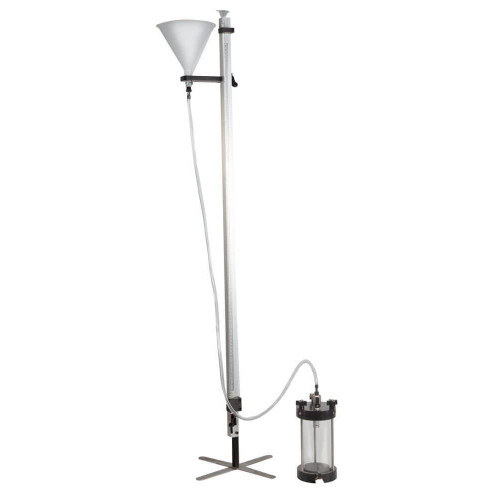
Constant / Falling Head Test Sets include a permeameter, Single Tube Manometer with Constant Head Reservoir, and Porous Stones or Perforated Plates, depending on permeameter size. The complete set is used to determine the coefficient of permeability for the laminar flow of water through granular soils. These economical Permeameters have the versatility for use with either constant head or falling head methods, with combined flow from the standpipe and tubing being integral to the flow rate calculation. The process involves allowing water to flow through the soil sample until it reaches a predetermined lower level, indicating the permeability of the tested soil. They are not equipped with sidewall manometer ports, so do not strictly meet requirements of ASTM / AASHTO methods. For testing cohesive soils, consider using a Chrome Plated Penetrometer. Permeameters are offered with inside diameters from 2.5in (63.5mm) — 9in (228.6mm) and are sized for sample lengths two times the diameter.
All models have clear acrylic chambers for observation during testing and anodized aluminum end caps. A spring applies 5-10lb (2.2-4.5kg) of force against the top stone or screen to prevent soil density changes during the test. Each chamber is equipped with valves, fittings, and either Porous Stones or Perforated Plates. Porous Stones are provided for 2.5in (63.5mm) through 4.5in (114.3mm) diameter models and Perforated Plates are included for 6in (152.6mm) and 9in (228.4mm) versions. Accurate measurement of water levels and flow rates is crucial, with the drop in water level within the standpipes being a key factor in calculating soil permeability. The tank provides a controlled flow environment essential for achieving accurate measurements of hydraulic conductivity in sediment samples. For further enhancing your soil analysis, consider the Compaction Tester for Soil for efficient measurement of soil compaction.
Features:
-
Economical and versatile for either constant head or falling head methods
-
Anodized aluminum end caps
-
Clear acrylic test chamber
-
Quality fittings for easy operation and long life
Included Items:
-
Constant / Falling Head Sand & Gravel Permeameter
-
Two Porous Stones
-
3859 Single Tube Manometer with Constant Head Reservoir for soil moisture testing with an Irrometer Tensiometer Model SR
-
Tubing
Soil Permeability Testing
Soil permeability testing is a key process in determining the ability of water to flow through soils, which is important in civil engineering, geotechnical engineering and environmental science. The falling head test is a widely used method for determining the permeability of fine-grained soils, including silts and clays, which have intermediate and low permeability. This testing method involves measuring the flow rate of water through a soil sample, typically using a falling head permeability cell or a constant head test setup. The hydraulic conductivity of the soil is then calculated based on the flow rate and pressure measurements. Soil permeability testing can be done on undisturbed samples or disturbed samples and is an important parameter in understanding groundwater flow and contaminant transport.
Equipment Components and Setup
The equipment components for soil, asphalt pavement testing equipment, and asphalt permeability testing include a falling head permeability cell, constant head reservoir, tubing, valves, and standpipe. The falling head permeability cell is used to measure the flow rate of water through the soil sample, the constant head reservoir is used to maintain a constant water level during the test, the tubing and valves are used to connect the permeability cell to the reservoir and to control the flow of water and the standpipe is used to measure the water level and pressure during the test. The setup of the equipment is critical to get accurate and reliable results and must be followed as per manufacturer’s instructions and standard testing protocols. The equipment must be calibrated regularly to ensure it is working correctly and the testing must be done under controlled laboratory conditions or in the field depending on the specific requirements of the test.
Operating Instructions and Safety Precautions
The operating instructions for permeability testing involve several steps including preparing the soil sample, setting up the equipment and conducting the test. The soil sample must be prepared as per the specific requirements of the test including drying, sieving and compacting. The equipment must be set up as per manufacturer’s instructions and the test must be conducted under controlled conditions. Safety precautions must be taken to avoid accidents and injuries including wearing protective clothing, gloves and safety glasses. The testing area must be well ventilated and the equipment must be handled with care to avoid damage. It must be followed as per standard testing protocols and manufacturer’s instructions and safety guidelines before conducting the test. The test must be done by trained personnel and the results must be interpreted and reported as per standard procedures.
Maintenance and Calibration
Maintenance and calibration of the equipment is crucial to get accurate and reliable results in permeability testing. The equipment should be cleaned and checked regularly to ensure it is working properly and any damaged or worn out parts should be replaced. Calibration should be done as per manufacturer’s instructions and verified regularly to ensure it is accurate. Testing protocols and procedures should be reviewed and updated regularly to match standard practices and guidelines. The person conducting the test should be trained and experienced in permeability testing and familiar with the equipment and testing protocols. Results should be interpreted and reported as per standard procedures and used for decision making and design for soil and groundwater management. Maintenance and calibration of the equipment will ensure results are accurate and reliable and testing is safe and efficient.