
Fast
Shipping

Quick,
Simple Ordering

Clear,
Upfront Pricing

Over 30,000
Happy Customers

Exceptional
Customer Service

Industry's Largest
Catalog
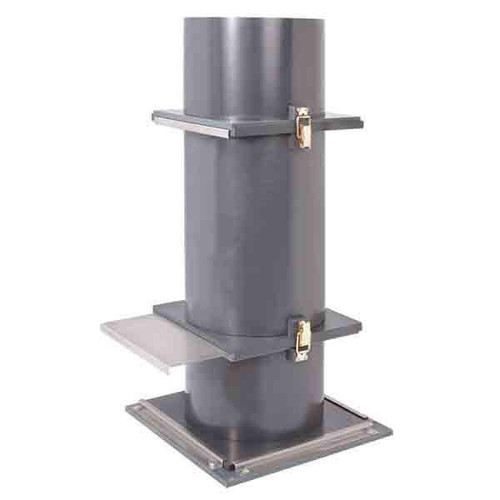
Static Segregation Column Mold for SCC Concrete
The Static Segregation Column Mold for Self-Consolidating Concrete is used to determine the potential for static segregation of Self-Consolidating Concrete (SCC) by measuring the coarse aggregate content in the top and bottom portions of a cylindrical specimen.
After filling the column with concrete, the bottom sample is collected from the lower tier for analysis. The column is filled with concrete and allowed to rest before examining the segregation of coarse aggregate within the sections. The middle section is discarded during analysis, while aggregate content is measured in the top and bottom sections.
This test is commonly used as a quality control test for coarse aggregate segregation, especially for deep section applications such as walls or columns.
The three-section column design plays a key role by allowing the concrete to be divided into three distinct sections for accurate evaluation. This test is not applicable for SCC with lightweight aggregate.
The mold includes:
- A stable base
- Three column sections
- Two sliding separator blades
These features allow the column to be disassembled while securely capturing the concrete sample in each section. The full-height main column is required for accurate segregation analysis.
Meets: ASTM C1610
Testing Introduction
In modern construction, the quality and durability of SCC are critical. Defects can occur when concrete fails to flow around reinforcement or into formwork during placement, leading to voids and structural flaws.
One of the most critical concerns is static segregation, where coarse aggregate separates from the mortar matrix. This weakens the structure and compromises long-term performance.
The Static Segregation Column Mold is an essential SCC testing tool that provides a reliable method for evaluating segregation resistance in fresh SCC mixes.
By measuring aggregate distribution across multiple sections, this test helps ensure:
- Mix consistency
- Proper flowability
- Structural integrity
Resistance to static segregation is essential for SCC to maintain its performance in confined and reinforced placements.
ASTM C1610 Static Segregation Testing
Designed specifically to meet ASTM C1610 requirements, this mold measures aggregate content in the top and bottom portions of a cylindrical specimen.
This is especially important in:
- Walls
- Columns
- Deep concrete sections
Uneven aggregate distribution can block concrete flow, causing voids and defects if SCC cannot pass through reinforcement or confined formwork.
The mold’s three-column configuration allows detailed sample analysis.
Sliding separator blades enable clean separation without disturbing the sample.
The mass of recovered aggregates from each section is compared to determine the percentage of static segregation.
⚠️ Not suitable for SCC containing lightweight aggregates.
How the Static Segregation Column Mold Works
- Concrete is placed into the column
- The column is allowed to rest
- Separator blades isolate the sections
- The middle tier is discarded
- Coarse aggregate from top and bottom sections is collected and weighed
The top tier slides horizontally, allowing samples to deposit directly into a collection vessel.
This design supports one-person operation and minimizes sample loss.
SCC Testing Challenges
Testing Self-Consolidating Concrete presents unique challenges due to its high flowability. While SCC eliminates vibration, it increases the risk of static aggregate segregation.
Key challenges include:
- Representative sampling
- Aggregate separation during handling
- Time-consuming test procedures
- Wear on sliding separator blades
The ASTM C1610 segregation column test method involves:
- Filling the column
- Allowing the mix to rest
- Recovering and washing aggregate
- Calculating segregation percentage
Improper handling or equipment wear can affect accuracy.
Why Use the Static Segregation Column Mold
Using a purpose-built segregation column helps overcome SCC testing challenges by offering:
- Rugged, corrosion-resistant construction
- Fast and easy cleanup
- Accurate separation of concrete sections
- One-person operation
- Reduced sample contamination
Proper maintenance of sliding blades and collection vessels ensures reliable, repeatable results.
Applications and Related Topics
The Static Segregation Column Mold is used in:
- Columns
- Walls
- Deep-section concrete placements
- Laboratory and field SCC testing
By comparing aggregate mass between sections, engineers can assess:
- Flowability
- Passing ability
- Risk of voids and defects
Related topics include:
The Static Segregation Column Mold for SCC is a must-have tool for anyone working with self-consolidating concrete. It provides fast, accurate segregation evaluation, ensuring SCC meets performance requirements for demanding applications.
By identifying segregation risks early, this test helps reduce structural flaws, improve durability, and ensure long-term project success