


Fast
Shipping

Quick,
Simple Ordering

Clear,
Upfront Pricing

Over 30,000
Happy Customers

Exceptional
Customer Service

Industry's Largest
Catalog
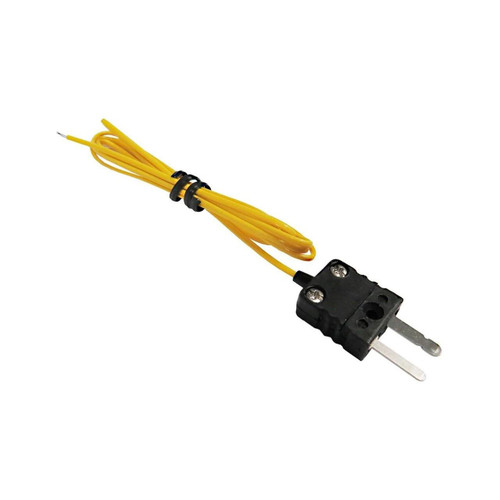
Type J Beaded Wire Thermometer Probe
The Type J Beaded Wire Thermometer Probe offers a versatile and rapid solution for temperature measurement in diverse applications. Known for its quick thermal response, this probe is particularly effective for monitoring temperatures in air and gas, especially in difficult-to-access or confined spaces.
Understanding Type J Thermocouples: Type J thermocouples are constructed from Iron (positive leg) and Constantan (negative leg). They provide a higher sensitivity of approximately 50 µV/°C compared to the more common Type K, making them excellent for detecting smaller temperature changes within their operational range. While the general Type J thermocouple can measure up to 750°C, this specific beaded wire probe is designed for a more restricted range due to its construction and insulation, offering optimal performance where high sensitivity at lower temperatures is critical.
Key Specifications for this Type J Beaded Wire Probe:
- Composition: Iron-Constantan
- Sensitivity: ~50 µV/°C
- Wire Color Standard: White (+) and Red (-)
- Application: Ideal for fast response measurements in air and gas environments, often utilized in laboratories, HVAC systems, or for spot-checking where a flexible, small-mass sensor is required.
- Temperature Range: -50°C to 200°C (-58°F to 392°F)
- Response Time: Extremely fast due to the low thermal mass of the exposed (beaded) junction.
- Dimensions: Cord Length: 36 inches (approx. 91 cm)
Comparing Type J vs. Type K: While Type K thermocouples (Nickel-Chromium/Nickel-Alumel) are the most common general-purpose option, offering a wider range of -50°C to +900°C with a sensitivity of ~41 µV/°C (yellow (+) and red (-)), Type J excels in specific scenarios. Choose Type J when:
- You need higher sensitivity for precise readings at lower to moderate temperatures.
- Operating in applications where a reducing atmosphere might degrade Type K sensors.
- Your temperature requirements fall within the -50°C to 200°C range, prioritizing fast response and accuracy.