



Fast
Shipping

Quick,
Simple Ordering

Clear,
Upfront Pricing

Over 30,000
Happy Customers

Exceptional
Customer Service

Industry's Largest
Catalog
Official Dockage Scales: Grain Dockage Sieves
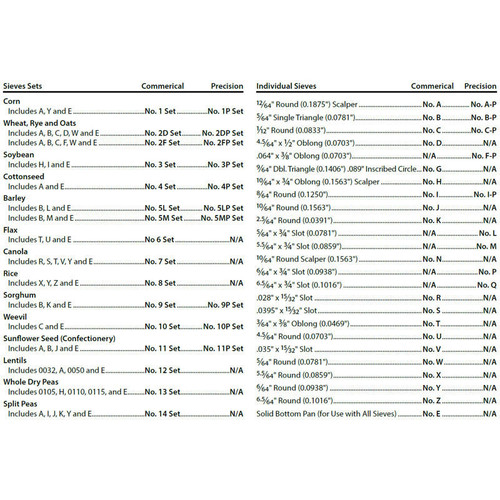
Dockage Sieves are made to meet the specifications of the U.S. Department of Agriculture.
Used by federal grain supervision offices, state grain inspection departments and licensed grain inspectors.
Most sieves are available in commercial or precision grades.
All federal grain inspectors use precision sieves but for most applications the commercial sieves will do.
Sieves should be replaced when the holes show wear to maintain accuracy and to be able to calculate dockage precisely. Slotted sieves used in sizing barley and oats need to be replaced often as these grains are very abrasive. A worn sieve lets too much material pass through and gives inaccurate results. Damaged or dented sieves should always be replaced.
Sieves are made of No. 20 gauge B & S aluminum. Decimal equivalents of diameter or width are shown in parentheses.
-
Actual dims: 13” Diameter x 23/8” Deep,
-
Sieves A, N and H: 13” Diameter x 2” Deep,
-
Pan E: 13” Diameter x 3” Deep.
Grain Grading
A grain scale is a must have in this process, it provides accurate measurements of dockage percentage, test weight and other parameters. The process of grading involves determining the weight of grains in pounds per bushel or kilograms per hectoliter and calculating the percentage of foreign material. Operators can use a grain scale to control the calculation of dockage percentage and weigh with ease. Using a grading scale ensures accuracy and efficiency in quality control, no errors and long term value.
Grain Grading Scale Basics
Grading is a critical process in the agricultural industry that ensures grains meet the standards for trade and commerce. The capacity of the grain grading scale which can measure up to 2000 grams is important for accuracy. This process involves evaluating the quality and quantity of grains by weighing, moisture content and foreign material percentage. Easy set up feature allows operators to quickly configure the scale for different testing needs, makes it convenient and versatile. A grain grading scale is a must have in this process, provides accurate and reliable measurements that is important for quality control.The grain grading scale should be able to calculate dockage foreign material percentage, test weight and determine weight in pounds per bushel or kilograms per hectoliter (kg hl). NTEP certification ensures that the scale meets the standards for legal trade use. Operators must have pinpoint control over the scale to be able to get precise measurements, to calculate dockage percentage and weight. The 7 button control interface makes it easy to access different functions and settings. Features include cup selection, active or frozen percent calculation and standard or reciprocal percentage calculation. Values can be stored in the scale’s memory for easy recall and calculation of percentages. These features helps in calculating dockage and to ensure that the grains meet the standards for trade. The user friendly design of the scale allows operators to navigate and edit configurations easily.
Features and Benefits
A grain grading scale has several features that makes it a must have in the agricultural industry. The GrainGrader is known for its ruggedness and precision, is a perfect example of such a scale. Its all-stainless construction ensures durability and easy maintenance. The 110 VAC filtered power supply reduces normal line noise, makes it accurate and efficient. The proprietary overload protection system ensures long life and prevents damage, makes the scale a good investment.
The scale can store sample values and has clear memory function to eliminate errors and get accurate and consistent results. Parameter programming allows operators to customize the scale to their needs, makes it versatile. Certified legal for trade and NTEP certified, the scale meets all the requirements. The power supply also has overload protection, adds to the scale’s durability and efficiency.
Using a grain grading scale has many benefits, increased efficiency, accuracy and quality control. It reduces quantity errors and ensures that grains meet the standards for trade and commerce. With features like all-stainless, proprietary overload protection and parameter programming, the scale provides long term value and reliability. The functions are easily accessible through individual push buttons, makes it user friendly and efficient.
Applications and Optimization
The applications of grain grading scales are many, from grain trading and storage to grain processing and handling. These scales have best-in-class features, proprietary protection, all-stainless and superior build quality. The all-stainless construction makes the scales easy to clean and maintain, the proprietary overload protection ensures long life and durability. Grain grading scales can be optimized for different applications by selecting the right cup size, quart, pint or liter and standard or reciprocal percentage mode. It can also do active or frozen percent calculation and test weight in pounds per bushel or kilograms per hectoliter. By using a grain grading scale, operators can get accurate and reliable grain grading which is required for legal-for-trade applications and GIPSA approved equipment list requirements. The scales can also be connected to a computer or printer via RS232C interface for easy data transfer and storage of sample values. Overall grain grading scales is a must have in the agricultural industry, provides accurate and efficient grain grading solutions that optimize quality control and compliance to regulatory requirements.