
Fast
Shipping

Quick,
Simple Ordering

Clear,
Upfront Pricing

Over 30,000
Happy Customers

Exceptional
Customer Service

Industry's Largest
Catalog
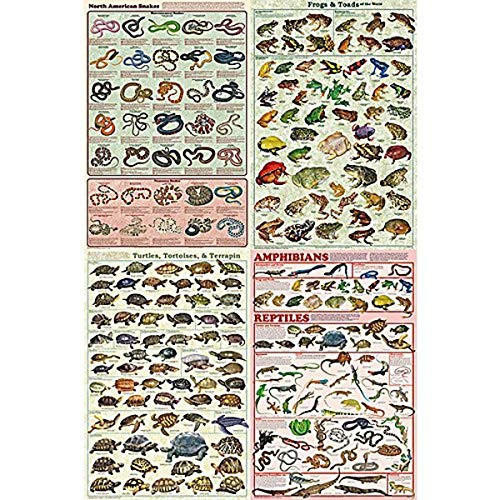
Fischer Technical REPPOS/SET, Reptiles And Amphibians Poster Set Of 4, Laminated
Description
This set Includes four lamInated posters. All posters are 24" x 36" Titles Included are: North American Snakes, Frogs & Toads, Turtles Tortoises and Terrapin, and Amphibians & Reptiles. A271 North American Snakes Snakes descend from lizards. Like them, they have loosely articulated skulls, and most can dislocate their lower jaw in order to swallow prey much larger than their own head. They differ from legless lizards by their lack of eyelids and external ears. Most species are non-venomous. They are generally shy and docile and try to avoid humans. Some are even kept as pets. The venomous snakes use their natural weapon primarily to subdue and kill prey. They are not normally aggressive, but when threatened, they will protect themselves. It’s best to avoid them, as some have venom powerful enough to cause painful injury or death. This causes many people to fear snakes. North Americans are justified in doing so because there are some really nasty serpents slithering around the countryside. This poster presents the most widespread North American species. It makes it easy to tell if a particular snake is a threat, as the graphic design divides them into non-venomous (green background) and venomous (red background) species. It’s the latter you really need to be able to identify because the others may give you a painful bite, but they won’t kill you. A274 Frogs & Toads The Anura (meaning “tail-less”) clade contains all of the frogs and toads. There are over 4,800 recorded species, which represents 88% of all amphibian species. The distinction between frogs and toads is based on common cultural rather than specific physical differences. In common usages, the term “frog” usually refers to species that are aquatic or semi-aquatic and have smooth, moist skins, and the term “toad” generally refers to species that are terrestrial with dry, warty skins, but there are numerous exceptions to this rule. This colorful poster is divided into three sections, one representing each of the major groups or sub-clades. Extensive research went into showing the amazing diversity of these little animals. North American species are shown whenever possible. A275 Turtles, Tortoises, & Terrapin These are the reptiles of the order Chelonii. All have a bony or cartilaginous shell, and many species withdraw into it for protection. Fossils have been dated to 220 million years ago, making turtles older than lizards, snakes, and crocodiles. Like other amniotes (reptiles, dinosaurs, birds, and mammals), they breathe air and do not lay eggs underwater, although many species live in or around water. The largest turtles are aquatic. Technically, all animals in this order are turtles, and the term can refer to the entire order or to any individual species. In common usage, the term tortoise refers to those that live only on land, and a terrapin is a turtle that lives in fresh or brackish water. These are common usage terms, not biological ones. There is only one terrapin species. A153 Amphibians & Reptiles These animals are often confused by people, so they are treated together. “Amphibian” comes from the Greek amphi, meaning “both,” and bios, meaning “life.” It has two meanings. First, the animals physically change. Reproduction is accomplished through external fertilization. The female spawns her eggs in water where they are fertilized by the male. After hatching, most amphibians undergo a dramatic change known as metamorphosis. They slowly change from fishlike, water-dwelling animals to ones better suited for life on land. Fins and gills become legs and lungs. The most well-known example is the change from tadpole to frog. Second, the term also refers to the fact that these animals live first in water and later on land. Reptiles reproduce by sexual intercourse and internal fertilization, just like mammals. Amniotic eggs develop within the mother’s abdomen. Once they are sufficiently developed, the mother lays them and they hatch. However, some reptiles give birth to live young.
Prop 65 Label
None