
Fast
Shipping

Quick,
Simple Ordering

Clear,
Upfront Pricing

Over 30,000
Happy Customers

Exceptional
Customer Service

Industry's Largest
Catalog
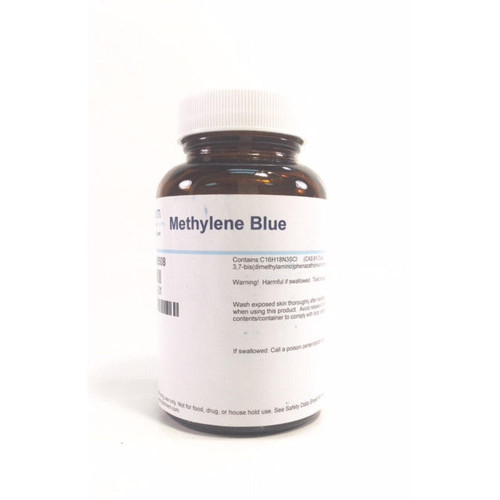
Methylene Blue Powder Reagent 25g
Methylene Blue Powder Reagent 25g is 98% pure. As a manufacturer we test and formulate each batch to the highest standard.
Please refer to the safety data sheet for information on stability, storage conditions, protective measures and disposal of the methylene blue solution.
Methylene Blue Powder Reagent is used in many scientific and medical applications. Its versatility makes it an essential tool in laboratories, research institutions and pharmaceutical companies. This product is for professionals who need an accurate and reliable reagent for their experiments and analysis. The use of blue dye, especially methylene blue, in medical applications such as lymphatic mapping and pharmacokinetics highlights its importance in absorption, distribution and excretion studies, safe for pregnant women.
With 98% purity it gives you accurate and consistent results in many applications. Whether you are doing medical diagnostics, microbiology studies or staining tissues in histopathology this product gives you the reliability and precision you need. Methylene blue is also used for blue staining in molecular biology techniques, so it’s a great tool for educational setting since it’s non toxic and more effective than SYBR Green and ethidium bromide.
The 25g packaging of Methylene Blue Powder Reagent is enough for your laboratory needs, it’s convenient and cost effective. The resealable container ensures the product longevity and integrity, so you have peace of mind and value for your money.
This product puts the safety of the professionals who use our products first. This Methylene Blue Powder Reagent is manufactured under strict quality control, meets the highest safety standard. We have thorough testing and quality assurance process in place so you can trust the consistency and reliability of this product.
Whether you are a scientist or a student doing experiments Methylene Blue Powder Reagent 25g is the best for your scientific and medical needs. Its high purity, enough supply and convenient, it’s a trusted tool in laboratories worldwide.
Choose MB-0025 for your research, analysis and diagnostic needs and experience the best quality and performance of this product.
Methylene Blue
Methylene blue, also known as methylthioninium chloride, is a multi-purpose compound used as a dye and a medication. Its medical use is in the treatment of methemoglobinemia, a condition where the ferric iron in hemoglobin is oxidized, reducing its ability for oxygen. Methylene blue reduces the oxidized form of hemoglobin back to its normal state, thus restoring the blood’s ability to transport oxygen. This is crucial in conditions where oxygen delivery to tissues is compromised. Beyond its medical applications, methylene blue is also used in laboratories for staining and as a redox indicator, so it’s a valuable tool in both clinical and research settings.
Pharmacology of Methylene Blue Injection
Mechanism of ActionMethylene blue reduces the oxidized form of hemoglobin (Fe3+) to its normal form (Fe2+) so the red blood cells can carry oxygen again. This is useful in treating methemoglobinemia where the blood cells are impaired in their oxygen carrying capacity. Methylene blue acts as a reversible inhibitor of monoamine oxidase A, which can lead to serotonin syndrome if combined with serotonergic drugs due to increased serotonin levels in the brain. Methylene blue staining is used for visualizing nucleic acids in agarose gels and on filter membranes. Methylene blue also inhibits endothelial nitric oxide synthase (eNOS), inducible nitric oxide synthase (iNOS) and guanylate cyclase, causing vasoconstriction of blood vessels. This is useful in managing vasoplegic syndrome. Methylene blue is also used in the treatment of malaria by reducing the resistance of Plasmodium falciparum to chloroquine and inhibiting the enzyme glutathione reductase so the antimalarial treatment is more effective.
Methylene Blue Uses
Methylene blue is a powerful reducing agent that converts the oxidized form of hemoglobin (Fe3+) back to its reduced form (Fe2+). Historically, methylene blue was used as an antiseptic for treating urinary tract infections, although this application is no longer recommended in clinical practice. This is important as it restores the ability of red blood cells to carry oxygen again which is useful in treating methemoglobinemia. Beyond that methylene blue is a competitive inhibitor of guanylate cyclase, blocks the vasodilatory action of nitric oxide. This is useful in managing vasoplegic syndrome. While methylene blue was assessed for its efficacy in treating acetaminophen toxicity in cats, it may actually diminish the beneficial effects associated with NAC (N-acetylcysteine) treatment. Methylene blue is also used in the treatment of various condition like malaria, ifosfamide-induced encephalopathy and potentially fatal serotonin toxicity. Its multiple uses make it a valuable tool in both clinical and laboratory setting.
Clinical Use of Methylene Blue Treatment
Ifosfamide Induced EncephalopathyMethylene blue is indicated for methemoglobinemia, a condition where there is an abnormal amount of methemoglobin in the blood which impairs the blood’s ability to carry oxygen. Methylene blue injection is also used for vasoplegic syndrome, a condition of severe vasodilation and low blood pressure often seen after cardiac surgery. Methylene blue is also effective against Plasmodium falciparum, the parasite that causes malaria and is used to treat ifosfamide-induced encephalopathy, a rare but serious side effect of the chemotherapy drug ifosfamide. Beyond these therapeutic uses, methylene blue is used as a diagnostic agent for sentinel lymph node mapping during breast procedures and parathyroid gland mapping during parathyroidectomies to help identify these critical structures.
Dosage and Administration
Methylene blue is administered intravenously to ensure rapid effect. Dosage and route of administration may vary depending on the condition being treated. For example in methemoglobinemia, 1 mg/kg of 1% solution is given over 5-30 minutes. For lymph node mapping 2-5 mL of 1% solution is given intraparenchymal. These specific dosages ensure that the treatment is both effective and safe for each condition.
Methylene Blue Treatment
Methylene blue is used to treat methemoglobinemia where the red type cells ability to carry air is severely impaired. By restoring the normal function of hemoglobin methylene blue relieves the symptoms of this condition. Methylene blue is also used to treat other serious condition like malaria, ifosfamide-induced encephalopathy and potentially fatal serotonin toxicity. Clinical studies have shown that methylene blue reduces mortality in methemoglobinemia and has been used to treat various other condition, hence its importance in modern medicine.
However, methylene blue may contribute to conditions such as serotonin syndrome when combined with certain medications.
Side Effects: Fatal Serotonin Toxicity
Methylene blue can cause blue-green discoloration of urine and limb pain after IV administration. One of the serious side effects of methylene blue is serotonin syndrome, a potentially fatal condition that occurs when combined with other serotonergic drugs and causes serotonin toxicity. Methylene blue treatment can also cause oxidative damage to red blood cells leading to regenerative anemia and various biochemical changes due to erythrocyte injury. Other side effects include central nervous system symptoms like dizziness, confusion and headaches in adults. In neonates methylene blue has caused hyperbilirubinemia, respiratory depression, pulmonary edema, phototoxicity and hemolytic anemia. These side effects highlight the need for close monitoring and proper dosing when using methylene blue in clinical practice. Methylene blue is also implicated in causing serotonin toxicity when used with certain medications, hence the importance of understanding these risks in clinical settings.
Contraindications
Methylene blue is contraindicated in patients who have had hypersensitivity or anaphylaxis to the drug in the past. At high doses it can cause methemoglobinemia which is risky especially in patients with G6PD deficiency. It is also contraindicated in patients with glucose-6-phosphate dehydrogenase (G6PD) deficiency as it can cause hemolytic anemia. Pregnant women should avoid methylene blue as it can harm the unborn baby. These contraindications emphasize the need for thorough patient evaluation before giving methylene blue.
Monitoring
Close monitoring is required for patients on methylene blue to ensure efficacy and safety of treatment. The time course of methylene blue in the blood after IV administration shows a multiphasic pattern including terminal half-life. Blood tests may be needed to detect any adverse effects and to monitor the patient’s response to treatment. Continuous medical supervision is crucial to prevent fatal serotonin toxicity and serotonin syndrome especially when methylene blue is given with other serotonergic drugs. This close monitoring will minimize the risks and achieve better outcome for the patient.
Regulatory Information and Guidelines
Methylene blue is subject to various regulatory guidelines especially in its use as a medication. In the European Union, methylene blue is approved for methemoglobinemia and is monitored by the European Medicines Agency. In the US, FDA has approved methylene blue for specific indications including methemoglobinemia and as a diagnostic agent. Health system pharmacists and medical professionals must follow these guidelines and be aware of the risk of serotonin syndrome when methylene blue is given with other serotonergic drugs. Dosage and administration route (IV for medical use) is critical in the safe and effective use of methylene blue. Methylene blue is also listed in the World Health Organization’s Essential Medicines, hence its importance in the health system globally.